Solution of Chapter 8. Body Movement (NCERT - Science Exemplar Book)
Chapter Exercises
Multiple Choice Questions
Which of the following parts of our body help us in movement?
(i) Bones
(ii) Skin
(iii) Muscles
(iv) Organs
Choose the correct answer from the option below.
view answer >Which of the following joints is immovable?
view answer >Which of the following organisms does not have both muscles and skeleton for movement?
view answer >Underwater divers wear fin-like flippers on their feet to
view answer >Snail moves with the help of its
view answer >How many muscles work together to move a bone?
view answer >Very Short Answer Questions
Name the type of joint of your hand which help you to grasp a badminton racquet.
view answer >What would have happened if our backbone was made of one single bone?
●
view answer >Provide one word answer to the statements given below.
1. Joint which allow movement in all directions.
2. Hard structure that forms the skeleton.
3. Part of the body with a fixed joint.
4. Help in the movement of body by contraction and relaxation.
5. Bones that join with chest bone at one end to the backbone at the other end.
6. Framework of bones which gives shape to our body.
7. Bones which enclose the organs of our body that lie below the abdomen.
8. Joint where our neck joints the head.
9. Part of the skeleton that forms the earlobe.
view answer >Write the type of joint which is used for each of the following movements :
(a) A cricket bowler bowls the ball.
(b) A girl moves her head in right and left direction.
(c) A person lifts weights to build up his biceps.
view answer >Short Answer Questions
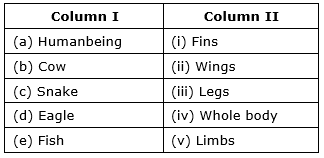
Match the name of the animals given in Column I with its body parts used for movement given in Column II
Given below is a list of different types of movement in animals.
Running, Jumping, Walking, Slithering,
Crawling, Flying, Swimming, Creeping
Write the type of movement seen in each animal.
(a) Duck
(b) Horse
(b) Kangaroo
(d) Snail
(e) Snake
(f) Fish
(g) Human beings
(h) Cockroach
view answer >Boojho fell off a tree and hurt his ankle. On examination the doctor confirmed that the ankle was fractured. How was it detected?
view answer >Bones are hard structures and cannot be bent. But, we can still bend our elbow, knee, etc. How is this possible?
view answer >Which type of movement would have been possible if
(a) our elbow had a fixed joint?
(b) we were to have a ball and socket joint between our neck and head.
view answer >Earthworms are known as ‘farmer’s friends’. Why?
view answer >Long Answer Questions
(a) Unscramble the jumbled words and write them in the blank spaces provided.
(i) neosb ……………….
(ii) themevom ………………..
(iii) iontcaronct …………………
(iv) lsecsum …………………
(v) arctigeal …………………….
(vi) epahs …………………….
(vii) sangro inerlan …………………….
(viii) laxaaeriont ……………………
view answer >Read the following paragraph and fill in the blanks using the words you unscrambled.
………(a)…….. and ………(b)…….. from the skeleton of the human body. They provide the framework. Give ……………(c)……….. to the body and help in ………….(d)………… They protect the …(e)……. The bones are moved by alternate …….(f)….. and …….(g)…… of two sets of ……(h)……… attached to them.
view answer >How is the skeleton of a bird well-suited for flying?
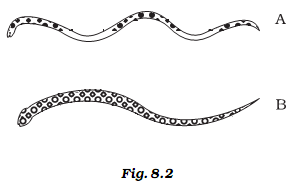
view answer >In Fig. 8.2 there are snakes of the same size slithering on the sand. Can you identify which of them would move faster and why?