Solution of Chapter 12. Electricity and Circuits (NCERT - Science Exemplar Book)
Chapter Exercises
Multiple Choice Questions
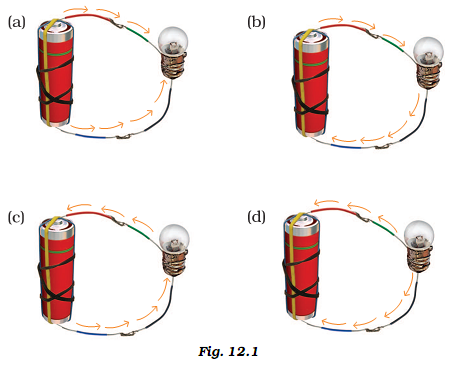
Choose from the options a, b, c, and d given in Fig. 12.1 the figure which shows the correct direction of the current.
Choose the incorrect statement.
view answer >In an electric bulb, light is produced due to the glowing of
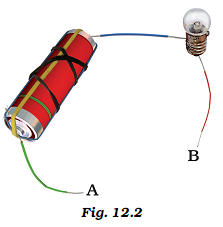
view answer >In the following arrangement shown in Fig. 12.2, the bulb will not glow if the ends A and B are connected with
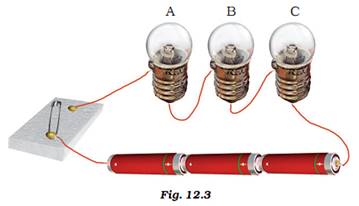
In the circuit shown in Fig. 12.3, when the switch is moved to ‘ON’ position,
The filament of a torch bulb is
view answer >Paheli is running short of connecting wires. To complete an electric circuit, she may use a
view answer >Very Short Answer Questions
In which of the following circuits A, B and C given in Fig. 12.4, the cell will be used up very rapidly? A B C Fig. 12.4 the cell will be used up very rapidly?
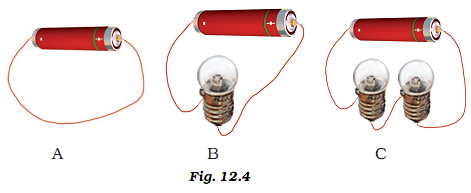
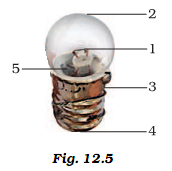
Fig. 12.5 shows a bulb with its different parts marked as 1, 2, 3, 4 and 5. Which of them label the terminals of the bulb?
Short Answer Questions
You are provided with a bulb, a cell, a switch and some connecting wires. Draw a diagram to show the connections between them to make the bulb glow.
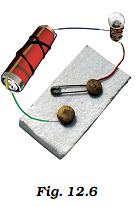
view answer >Will the bulb glow in the circuit shown in Fig. 12.6? Explain.
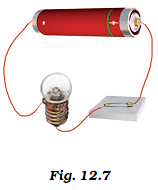
An electric bulb is connected to a cell through a switch as shown in Fig. 12.7. When the switch is brought in ‘ON’ position, the bulb does not glow. What could be the possible reasons for it? Mention any two of them.
A torch requires 3 cells. Show the arrangement of the cells, with a diagram, inside the torch so that the bulb glows.
view answer >When the chemicals in the electric cell are used up, the electric cell stops producing electricity. The electric cell is then replaced with a new one. In case of rechargeable batteries (such as the type used in mobile phones, camera and inverters), they are used again and again. How?
view answer >Paheli connected two bulbs to a cell as shown in Fig. 12.8.
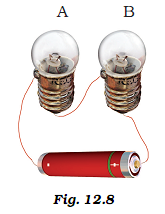
She found that filament of bulb B is broken. Will the bulb A glow in this circuit? Give reason.
view answer >Why do bulbs have two terminals?
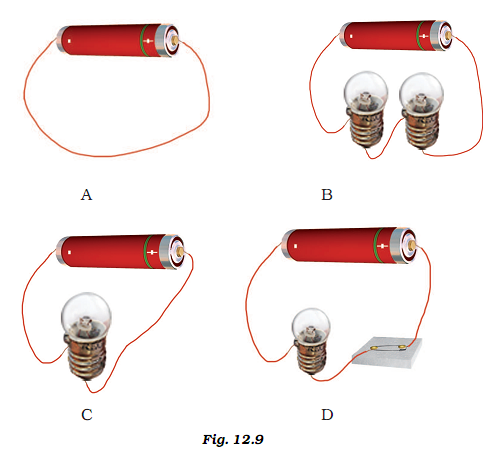
view answer >Which of the following arrangement A, B, C and D given in Fig. 12.9 should not be set up? Explain, why.
A fused bulb does not glow. Why?
view answer >Paheli wanted to glow a torch bulb using a cell. She could not get connecting wires, instead, she got two strips of aluminum foil. Will she succeed? Explain, how?
view answer >Long Answer Questions
Boojho has a cell and a single piece of connecting wire. Without cutting the wire in two, will he be able to make the bulb glow? Explain with the help of a circuit diagram.
view answer >Fig. 12.10 A and B, show a bulb connected to a cell in two different ways.
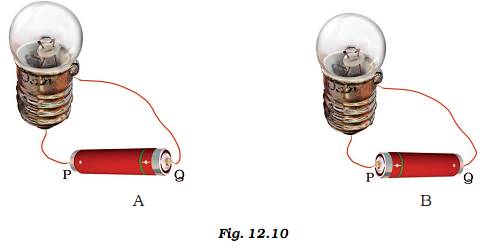
(i) What will be the direction of the current through the bulb in both the cases. (Q to P or P to Q)
(ii) Will the bulb glow in both the cases?
(iii) Does the brightness of the glowing bulb depend on the direction of current through it?
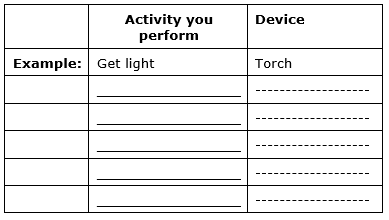
view answer >Think of six activities which use electric current. Also name the devices used to perform the activity.
A torch is not functioning, though contact points in the torch are in working condition. What can be the possible reasons for this? Mention any three.
view answer >