Solution of Chapter 8. Cell—Structure and Functions (NCERT Science Exemplar Book)
Chapter Exercises
Multiple Choice Questions
Choose the correct statement with respect to unicellular organisms:
view answer >Majority of cells cannot be seen directly with our naked eyes because:
view answer >Read the different combinations of terms given below:
The correct combination of terms with reference to an animal cell is _____.
view answer >Which one of the following term is not a part of the nucleus?
view answer >A suitable term for the various components of cells is
view answer >The jelly-like fluid substance present in cells is called
view answer >Read the following pairs of examples of organisms:
The pair that belongs to the group prokaryotes is_____
view answer >Read the following terms and select the pair that is related to inheritance of characters.
view answer >Choose the correct statement:
view answer >Green colour of leaves is due to presence of the pigment_____
view answer >The unit of measurement used for expressing the dimension (size) of cells is:
view answer >The most important function of the cell membrane is that it:
view answer >Paheli accidentally placed her hand over a flame and immediately pulled it back. She felt the sensation of heat and reacted due to the action of
view answer >Of the following parts of a cell listed below, name the part that is common to plant cell, animal cell, and a bacterial cell.
view answer >The thread-like structures present in the nucleus are
view answer >Identify the statement which is true for cells.
view answer >Which of the following is not a cell?
view answer >Which of the following feature will help you in distinguishing a plant cell from an animal cell?
view answer >Under a microscope, Paheli observes a cell that has a cell wall but no distinct nucleus. The cell that she observes is
view answer >Cheek cells do not have _______
view answer >Identify the correct statement.
view answer >Which of the following statements are true for eukaryotic cells?
(i) They do not have a nuclear membrane.
(ii) They have a well-organized nucleus.
(iii) They have a nuclear membrane.
(iv) Blue-green algae are eukaryotic cells.
view answer >Identify the correct statement about cells.
view answer >The table given below has certain terms and four blank spaces named A, B, C, and D.

From the options given below choose the correct combination of terms.
view answer >Very Short Answer Type
In leaves, name the cell organelle and pigment that is responsible for green color.
view answer >The instrument used to observe cells is ________
view answer >We do not sense any pain when we clip our nails or cut our hair. Why?
view answer >In a cell, where are the genes located?
view answer >Amoeba and Paramecium belong to which category of organisms?
view answer >What are the functions of the cell wall in plant cells?
view answer >Short Answer Type
Is the following statement correct? If it is wrong, correct the statement
Statement: “Unicellular organisms do not respire, only multicellular organisms respire”
view answer >Match the terms given in column I with their functions given in column II and fill the blanks given below the table:
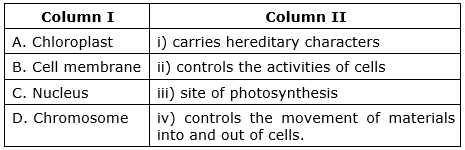
A-_____; B-______; C-______; D-______
view answer >Observe the following diagram given as Fig. 8.1.
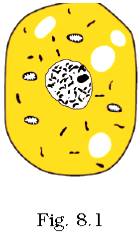
Answer the following questions.
A. Does it represent a plant cell or an animal cell?
B. Does it represent a prokaryotic cell or a eukaryotic cell?
view answer >Label the parts A to E in the given as Fig. 8.2 diagram.

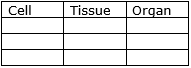
Classify the following terms into cells, tissues, and organs and write in the tabular column given below.
RBC, WBC, Nerve cell, blood, muscle, blood vessels, brain, heart, hand
Read the following statements and write the appropriate term against each statement.
A. I control the functions of a cell. Who am I? ...................
B. I am like a policeman. I do not allow anything and everything to get in and out of the cell. Who am I? ...................
C. I transfer characters from parents to off springs. Who am I? ..................
view answer >Fill in the blanks with the terms given in the box below:
Nucleus, chromosomes, cell wall, cell membrane, protoplasm, cytoplasm, ribosome, cell organelles
The outermost layer of plant cells is the (a) beneath which is the …..(b) …….The term ….(c)….. refers to the jelly-like substance containing all the ….(d)….. The …..(e)…. contains thread-like structures called ….(f)…...
view answer >Long Answer Type
Cells consist of many organelles, yet we do not call any of these organelles as structural and functional unit of living organisms. Explain.
view answer >Why do plant cells have an additional layer surrounding the cell membrane? What is this layer known as?
view answer >The size of the cells of an organism has no relation to the size of its body. Do you agree? Give a reason for your answer.
view answer >