Solution of Chapter 14. Chemical Effects of Electric Current (NCERT Science Exemplar Book)
Chapter Exercises
Multiple Choice Questions
An electric current can produce
view answer >Boojho and Paheli performed experiments taking similar bulbs and cells but two different solutions A and B as shown in Fig.14.1.
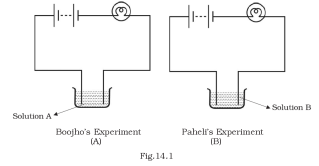
They found that the bulb in the setup A glows more brightly as compared to that of the setup B. You would conclude that
view answer >
Boojho’s uncle has set up an electroplating factory near his village. He should dispose off the waste of the factory
view answer >When electric current is passed through a conducting solution, there is a change of colour of the solution. This indicates
view answer >Which one of the following solutions will not conduct electricity?
view answer >Which of the following metals is used in electroplating to make objects appear shining?
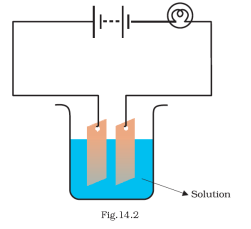
view answer >Which of the following solutions will not make the bulb in Fig 14.2 glow?
view answer >
Very Short Answer Type
Fill in the blanks
(a) The object to be electroplated is taken as ____________ electrode.
(b) One of the most common applications of chemical effect of electric current is ______________.
(c) Small amount of a mineral salt present naturally in water makes it a______________ of electricity.
(d) Electroplating of ______________ is done on objects like water taps and cycle bell to give them a shiny appearance.
view answer >
Why is a layer of zinc coated over iron?
view answer >Will the solution of sugar in distilled water conduct electricity?
view answer >Name the effect of current responsible for the glow of the bulb in an electric circuit.
view answer >Short Answer Type
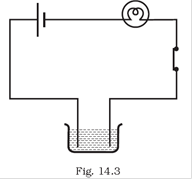
Boojho made the circuit given in Fig. 14.3 and observed that the bulb did not glow. On Paheli’s suggestion he added one more cell in the circuit. The bulb now glows. Explain.
view answer >
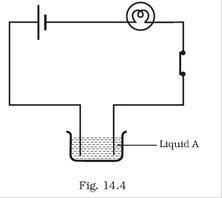
Paheli set up an experiment using liquid A in the beaker as shown in Fig. 14.4. She observed that the bulb glows. Then she replaced the liquid A by another liquid B. This time the bulb did not glow. Boojho suggested replacing the bulb by an LED. They observed that the LED glows. Explain.
view answer >
Paheli wants to deposit silver on an iron spoon. She took silver nitrate (AgNO3) solution in a beaker and setup a simple circuit for electroplating. Which terminal of the battery should the spoon be connected to? What material should the other electrode be made of?
view answer >Why is tin electroplated on iron to make cans used for storing food?
view answer >Observe Fig. 14.5.
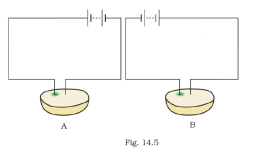
Which of these two circuits A or B shows the correct observation?
view answer >
Observe the following circuits carefully. In which circuit will the bulb glow. Write ‘Yes’ or ‘No’ in the blank space provided along each of the circuit given in Fig. 14.6.
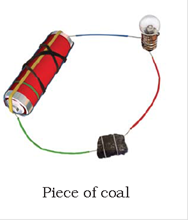
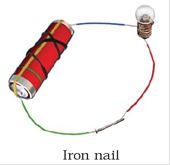
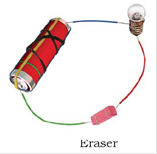
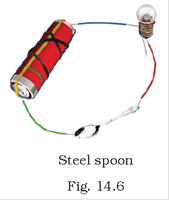
view answer >
Long Answer Type
An electric current is passed through a conducting solution. List any three possible observations.
view answer >In the circuit given as Fig. 14.7, Boojho observed that copper is deposited on the electrode connected to the negative terminal of the battery. Paheli tried to repeat the same experiment. But she could find only one copper plate. Therefore, she took a carbon rod as negative electrode. Will copper be still deposited on the carbon rod? Explain your answer.
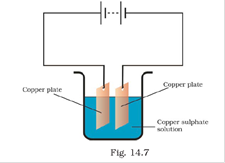
view answer >
Observe the circuit given in Fig. 14.8.
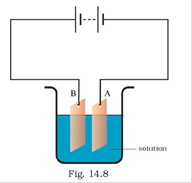
Boojho set up this circuit for purification of copper. What will be the nature of – (i) plate A (ii) plate B (iii) the solution. Explain the process of purification.
view answer >
Observe the following circuit given in Fig. 14.9.
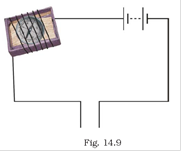
Current does not flow in the circuit if there is a gap between the two wires. Does it indicate that air is a poor conductor of electricity? Does air never conduct electricity? Explain.
view answer >
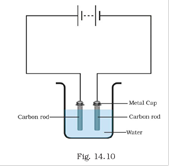
Boojho made the circuit shown in Fig. 14.10. He wanted to observe what happens when an electric current is passed through water. But he forgot to add a few drops of lemon juice to water. Will it make any difference to his observations? Explain.
view answer >
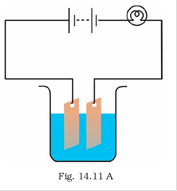
Observing that the bulb does not glow in the circuit shown in Fig. 14.11 A, Boojho changed the circuit as shown in Fig 14.11 B. He observed deflection in the magnetic compass.
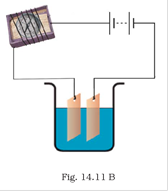
(i) What does the deflection in magnetic compass indicate?
(ii) Why did the bulb not glow in Fig.14.11 A?
(iii) What would be the effect of increase in the number of turns in the coil wound around the magnetic compass in Fig. 14.11B?
(iv) What will be observed if the number of cells are increased in the circuit shown in Fig. 14.11B?
view answer >
You are provided with a magnetic compass, an empty match box, a battery of two cells and connecting wires. Using these objects how will you make a tester for testing an electric circuit? Draw the necessary circuit diagram and explain.
view answer >