Solution of Chapter 16. Light (NCERT Science Exemplar Book)
Chapter Exercises
Multiple Choice Questions
Part of the eye which controls the light entering is called
view answer >We can see a non-luminous object when light:
view answer >Light is falling on surface S1, S2, S3 as shown in Fig.16.1.
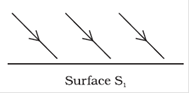
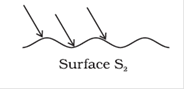
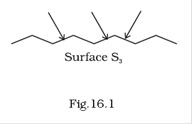
Surfaces on which the angle of incidence is equal to the angle of reflection is/are
view answer >
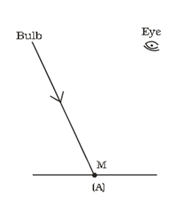
A tiny mirror M is fixed on a piece of cardboard placed on a table. The cardboard is illuminated by light from a bulb. The position of eye with respect to position of bulb is shown in Fig.16.2 as A, B, C and D. In which position mirror will be visible?
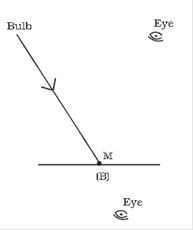
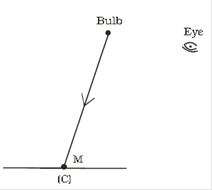
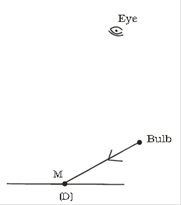
view answer >
A small hole P is made in a piece of cardboard. The hole is illuminated by a torch as shown in Fig. 16.3. The pencil of light coming out of the hole falls on a mirror.
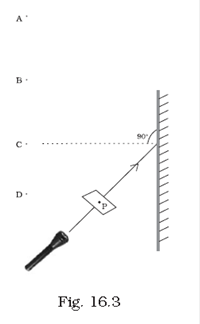
At which point should the eye be placed so that the hole can be seen?
view answer >
Two mirrors A and B are placed at right angles to each other as shown in Fig.16.4.
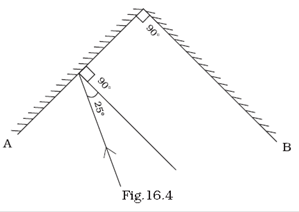
A ray of light incident on mirror A at an angle of 250 falls on mirror B after reflection. The angle of reflection for the ray reflected from mirror B would be
view answer >
Which of the following statements is correct regarding rods and cones in the human eye?
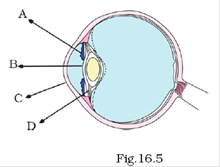
view answer >In the figure of the human eye (Fig.16.5), the cornea is represented by the letter
view answer >
Very Short Answer Type
Name the part of the eye which gives colour to the eyes.
view answer >Boojho while waving his hand very fast in front of his eyes, observes that his fingers appear blurred. What could be the reason for it?
view answer >How many times is a ray of light reflected by two plane mirrors placed parallel and facing each other?
view answer >The angle between incident ray and reflected ray is 60°. What is the value of angle of incidence?
view answer >The distance between the object and its image formed by a plane mirror appears to be 24 cm. What is the distance between the mirror and the object?
view answer >Short Answer Type
What happens to light when it gets dispersed? Give an example.
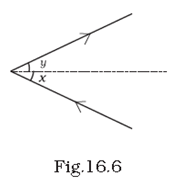
view answer >Draw Fig.16.6 showing the position of the plane mirror. Also label the angle of incidence and angle of reflection on it.
view answer >
Look at Fig.16.7. Can the image of the child in it be obtained on a screen?
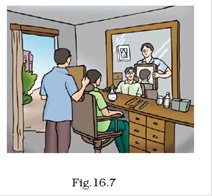
view answer >
Eyes of the nocturnal birds have large cornea and a large pupil. How does this structure help them?
view answer >What kind of lens is there in our eyes? Where does it form the image of an object?
view answer >Which part of the eye gets affected if someone is suffering from cataract? How is it treated?
view answer >Long Answer Type
Boojho planned an activity to observe an object A through pipes as shown in Fig. 16.8, so that he could see objects which he could not directly see.
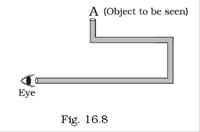
(a) How many mirrors should he use to see the objects?
(b) Indicate the positions of the mirrors in the figure.
(c) What must be the angle with respect to the incident light at which he should place the mirrors?
(d) Indicate the direction of rays in the figure.
(e) If any of the mirrors is removed, will he be able to see the objects?
view answer >
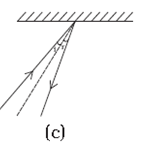
There is a mistake in each of the following ray diagrams given as Fig. 16.9 a, b, and c. Make the necessary correction (s).
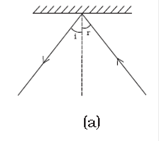
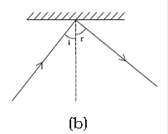
view answer >
Explain the process which enables us to perceive motion in a cartoon film.
view answer >How is the phenomenon of reflection used in making a kaleidoscope? What are the applications of a kaleidoscope?
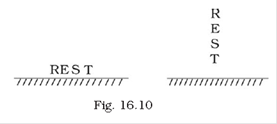
view answer >Fig. 16.10 shows the word REST written in two ways in front of a mirror. Show how the word would appear in the mirror.
view answer >
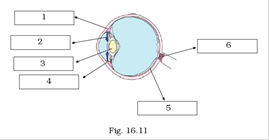
Write down the names of parts of the eye in the blank spaces shown in Fig. 16.10.
view answer >