Solution of Chapter 4. Structure of The Atom (NCERT Science Exemplar Book)
Chapter Exercises
Multiple Choice Questions
Which of the following correctly represents the electronic distribution in the Mg atom?
view answer >Rutherford’s ‘alpha (α) particles scattering experiment’ resulted into discovery of
view answer >The number of electrons in an element X is 15 and the number of neutrons is 16. Which of the following is the correct representation of the element?
view answer >Dalton’s atomic theory successfully explained
(i) Law of conservation of mass
(ii) Law of constant composition
(iii) Law of radioactivity
(iv) Law of multiple proportions
view answer >Which of the following statements about Rutherford’s model of atom are correct?
(i) considered the nucleus as positively charged
(ii) established that the α–particles are four times as heavy as a hydrogen atom
(iii) can be compared to solar system
(iv) was in agreement with Thomson’s model
view answer >Which of the following are true for an element?
(i) Atomic number = number of protons + number of electrons
(ii) Mass number = number of protons + number of neutrons
(iii) Atomic mass = number of protons = number of neutrons
(iv) Atomic number = number of protons = number of electrons
view answer >In the Thomson’s model of the atom, which of the following statements are correct?
(i) the mass of the atom is assumed to be uniformly distributed over the atom
(ii) the positive charge is assumed to be uniformly distributed over the atom
(iii) the electrons are uniformly distributed in the positively charged sphere
(iv) the electrons attract each other to stabilize the atom
view answer >Rutherford’s α–particle scattering experiment showed that
(i) electrons have a negative charge
(ii) the mass and positive charge of the atom is concentrated in the nucleus
(iii) neutron exists in the nucleus
(iv) most of the space in an atom is empty
Which of the above statements are correct?
view answer >The ion of an element has 3 positive charges. A mass number of the atom is 27 and the number of neutrons is 14. What is the number of electrons in the ion?
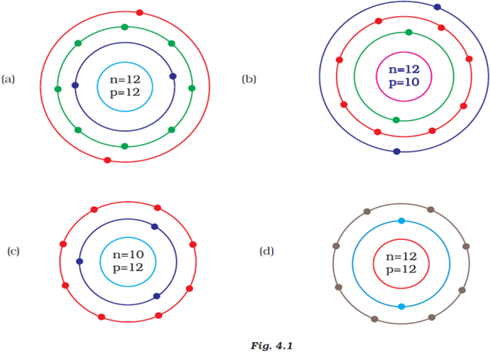
view answer >Identify the Mg2+ ion from the Fig.4.1 where n and p represent the number of neutrons and protons respectively
In a sample of ethyl ethanoate (CH3COOC2H5) the two oxygen atoms have the same number of electrons but different number of neutrons. Which of the following is the correct reason for it?
view answer >Elements with valency 1 are
view answer >The first model of an atom was given by
view answer >An atom with 3 protons and 4 neutrons will have a valency of
view answer >The electron distribution in an aluminium atom is
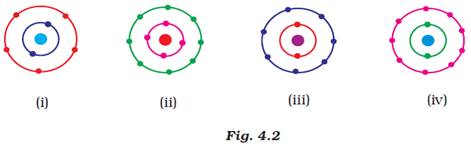
view answer >Which of the following in Fig. 4.2 do not represent Bohr’s model of an atom correctly?
Which of the following statement is always correct?
view answer >Atomic models have been improved over the years. Arrange the following atomic models in the order of their chronological order
(i) Rutherford’s atomic model
(ii) Thomson’s atomic model
(iii) Bohr’s atomic model
view answer >Short Answer Type
Is it possible for the atom of an element to have one electron, one proton and no neutron. If so, name the element.
view answer >Write any two observations which support the fact that atoms are divisible.
view answer >Will Cl35and Cl37have different valencies? Justify your answer.
view answer >Why did Rutherford select a gold foil in his α–ray scattering experiment?
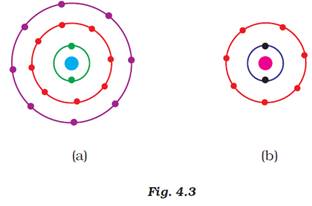
view answer >Find out the valency of the atoms represented by the Fig. 4.3 (a) and (b).
One electron is present in the outermost shell of the atom of an element X. What would be the nature and value of charge on the ion formed if this electron is removed from the outermost shell?
view answer >Write down the electron distribution of chlorine atom. How many electrons are there in the L shell? (Atomic number of chlorine is 17).
view answer >In the atom of an element X, 6 electrons are present in the outermost shell. If it acquires noble gas configuration by accepting requisite number of electrons, then what would be the charge on the ion so formed?
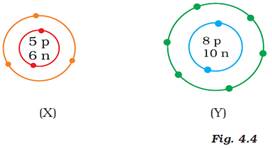
view answer >What information do you get from the Fig. 4.4 about the atomic number, mass number and valency of atoms X, Y and Z? Give your answer in a tabular form.
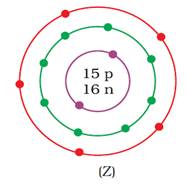
In response to a question, a student stated that in an atom, the number of protons is greater than the number of neutrons, which in turn is greater than the number of electrons. Do you agree with the statement? Justify your answer.
view answer >Calculate the number of neutrons present in the nucleus of an element X which is represented as 3115
view answer >Match the names of the Scientists given in column A with their contributions towards the understanding of the atomic structure as given in column B
(A) | (B) |
(a) Ernest Rutherford | (i) Indivisibility of atoms |
(b) J.J.Thomson | (ii) Stationary orbits |
(c) Dalton | (iii) Concept of nucleus |
(d) Neils Bohr | (iv) Discovery of electrons |
(e) James Chadwick | (v) Atomic number |
(f) E. Goldstein | (vi) Neutron |
(g) Mosley | (vii) Canal rays |
The atomic number of calcium and argon are 20 and 18 respectively, but the mass number of both these elements is 40. What is the name given to such a pair of elements?
view answer >Complete the Table 4.1 on the basis of information available in the symbols given below
view answer >Helium atom has 2 electrons in its valence shell but its valency is not 2, Explain.
view answer >Fill in the blanks in the following statements
(a) Rutherford’s α-particle scattering experiment led to the discovery of the __________
(b) Isotopes have same _______ but different _______
(c) Neon and chlorine have atomic numbers 10 and 17 respectively. Their valencies will be _____ and _____ respectively.
(d) The electronic configuration of silicon is ______ and that of sulphur is _____
view answer >An element X has a mass number 4 and atomic number 2. Write the valency of this element?
view answer >Long Answer Type
Why do Helium, Neon and Argon have a zero valency?
view answer >The ratio of the radii of hydrogen atom and its nucleus is ~ 105. Assuming the atom and the nucleus to be spherical,
(i) what will be the ratio of their sizes?
(ii) If atom is represented by planet earth ‘Re’ = 6.4 ×10 m, estimate the size of the nucleus.
view answer >Enlist the conclusions drawn by Rutherford from his α-ray scattering experiment.
view answer >In what way is the Rutherford’s atomic model different from that of Thomson’s atomic model?
view answer >What were the drawbacks of Rutherford’s model of an atom?
view answer >What are the postulates of Bohr’s model of an atom?
view answer >Show diagrammatically the electron distributions in a sodium atom and a sodium ion and also give their atomic number.
view answer >In the Gold foil experiment of Geiger and Marsden, that paved the way for Rutherford’s model of an atom, ~ 1.00% of the α-particles were found to deflect at angles > 50°. If one mole of α-particles were bombarded on the gold foil, compute the number of α-particles that would deflect at angles less than 500.
view answer >