Solution of Chapter 8. Motion (NCERT Science Exemplar Book)
Chapter Exercises
Multiple Choice Questions
A particle is moving in a circular path of radius r. The displacement after half a circle would be:
view answer >A body is thrown vertically upward with velocity u, the greatest height h to which it will rise is,
view answer >The numerical ratio of displacement to distance for a moving object is
view answer >If the displacement of an object is proportional to square of time, then the object moves with
view answer >From the given v – t graph (Fig. 8.1), it can be inferred that the object is

Suppose a boy is enjoying a ride on a merry-go-round which is moving with a constant speed of 10 m/s I. t implies that the boy is
view answer >Area under a v – t graph represents a physical quantity which has the unit
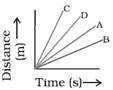
view answer >Four cars A, B, C and D are moving on a levelled road. Their distance versus time graphs are shown in Fig. 8.2. Choose the correct statement
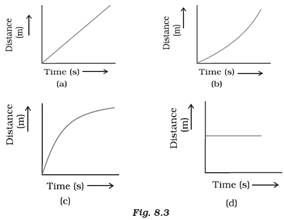
Which of the following figures (Fig. 8.3) represents uniform motion of a moving object correctly?
Slope of a velocity – time graph gives
view answer >In which of the following cases of motions, the distance moved and the magnitude of displacement are equal?
view answer >Short Answer Type
The displacement of a moving object in a given interval of time is zero. Would the distance travelled by the object also be zero? Justify your answer.
view answer >How will the equations of motion for an object moving with a uniform velocity change?
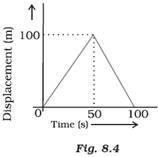
view answer >A girl walks along a straight path to drop a letter in the letterbox and comes back to her initial position. Her displacement–time graph is shown in Fig.8.4.
Plot a velocity–time graph for the same.
A car starts from rest and moves along the x-axis with constant acceleration 5 m s–2 for 8 seconds. If it then continues with constant velocity, what distance will the car cover in 12 seconds since it started from the rest?
view answer >A motorcyclist drives from A to B with a uniform speed of 30 km h–1 and returns back with a speed of 20 km h–1. Find its average speed.
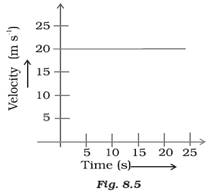
view answer >The velocity-time graph (Fig. 8.5) shows the motion of a cyclist. Find
(i) its acceleration
(ii) its velocity and
(iii) the distance covered by the cyclist in 15 seconds.
Draw a velocity versus time graph of a stone thrown vertically upwards and then coming downwards after attaining the maximum height.
view answer >Long Answer Type
An object is dropped from rest at a height of 150 m and simultaneously another object is dropped from rest at a height 100 m. What is the difference in their heights after 2 s if both the objects drop with same accelerations? How does the difference in heights vary with time?
view answer >An object starting from rest travels 20 m in first 2 s and 160 m in next 4 s. What will be the velocity after 7 s from the start?
view answer >Using following data, draw time - displacement graph for a moving object:
Time (s) | 0 2 4 6 8 10 12 14 16 |
Displacement (m) | 2 4 4 4 6 4 2 0 |
Use this graph to find average velocity for first 4 s, for next 4 s and for last 6 s.
view answer >An electron moving with a velocity of 5×10⁴ m s-1 enters into a uniform electric field and acquires a uniform acceleration of 104 m s–2 in the direction of its initial motion.
(i) Calculate the time in which the electron would acquire a velocity double of its initial velocity.
(ii) How much distance the electron would cover in this time?
view answer >Obtain a relation for the distance travelled by an object moving with a uniform acceleration in the interval between 4th and 5th seconds.
view answer >Two stones are thrown vertically upwards simultaneously with their initial velocities u and u respectively. Prove that the heights reached by them would be in the ratio of  :
:  (Assume upward acceleration is –g and downward acceleration to be +g).