Solution of Chapter 8. Motion (NCERT - Science Book)
Chapter Exercises
In Text Questions-Pg-100
An object has moved through a distance. Can it have zero displacement? If yes, support your answer with an example.
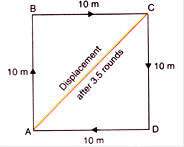
view answer >A farmer moves along the boundary of a square field of side 10 m in 40 s. What will be the magnitude of displacement of the farmer at the end of 2 minutes 20 seconds from his initial position?
Which of the following is true for displacement?
(a) It cannot be zero.
(b) Its magnitude is greater than the distance travelled by the object.
view answer >In Text Questions-Pg-102
Distinguish between speed and velocity.
view answer >Under what condition(s) is the magnitude of average velocity of an object equal to its average speed?
view answer >What does the odometer of an automobile measure?
view answer >What does the path of an object look like when it is in uniform motion?
view answer >During an experiment, a signal from a spaceship from the ground station, the signal travels at the speed of light i.e., 3×10⁸ m s-1.
view answer >In Text Questions-Pg-103
When will you say a body is in?
(i) Uniform acceleration?
(ii) Non - uniform acceleration?
view answer >A bus decreases its speed from 80 km h-1 to 60 km h-1 in 5 s. Find the acceleration of the bus.
view answer >A train starting from a railway station and moving with uniform acceleration attains a speed of 40 km h-1 in 10 minutes. Find its acceleration.
view answer >In Text Questions-Pg-107
What is the nature of the distance time graphs for uniform and non-uniform motion of an object?
view answer >What can you say about the motion of an object whose distance time graph is a straight line parallel to the time-axis?
view answer >What can you say about the motion of an object if its speed-time graph is a straight line parallel to the time axis?
view answer >What is the quantity which is measured by the area occupied below the velocity-time graph?
view answer >In Text Questions-Pg-109
A bus starting from rest moves with a uniform acceleration of 0.1 ms-2 for 2 minutes. Find:
(a) The speed acquired.
(b) The distance travelled.
view answer >A train is travelling at a speed of 90 km h-1. Brakes are applied so as to produce a uniform acceleration of, -0.5 m s-2. Find how far the train will go before it is brought to rest.
view answer >A trolley, while going down an inclined plane, has an acceleration of 2 cm s-2. What will be its velocity 3 s after the start?
view answer >A racing car has a uniform acceleration of 4 m s-2. What distance will it cover in 10 s after start?
view answer >A stone is thrown in vertically upward direction with a velocity of 5 m s-1. If the acceleration of the stone during its motion is 10 m s-2 in the downward direction, what will be the height attained by the stone and how much time will it take to reach there?
view answer >Exercise-Pg-112
An athlete completes one round of a circular track of diameter 200 m in 40 s. What will be the distance covered and the displacement at the end of 2 minutes 20 s?
view answer >Joseph jogs from one end A to the other end B of a straight 300 m road in 2 minutes 30 seconds and then turns around and jogs 100 m back to point C in another 1 minute. What are Joseph’s average speeds and velocities in jogging?
(a) From A to B
(b) From A to C
view answer >Abdul, while driving to school, computes the average speed for his trip to be 20 km h-1. On his return trip along the same route, there is less traffic and the average speed is 30 km h-1. What is the average speed for Abdul’s trip?
view answer >A motorboat starting from rest on a lake accelerates in a straight line at a constant rate of 3.0 m s-2 for 8.0 s. How far does the boat travel during this time?
view answer >A driver of a car travelling at 52 km h-1 applies the brakes and accelerates uniformly in the opposite direction. The car stops in 5 s. Another driver going at 34 km h-1 in another car applies his breakes slowly and stops in 10 s. On the same graph paper, plot the speed versus time graphs for the two cars. Which of the two cars travelled farther after the brakes were applied?
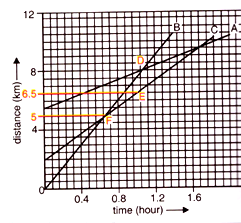
view answer >Figure shows the distance-time graphs of three objects A, B and C. Study the graphs and answer the following questions:
(a) Which of the three is travelling the fastest?
(b) Are all three ever at the same point on the road?
(c) How far has C travelled when B passes A?
(d) How far has B travelled by the time it passes C?
A ball is gently dropped from a height of 20 m. If its velocity increases uniformly at the rate of 10 m s-2, with what velocity will it strike the ground? After what time will it strike the ground?
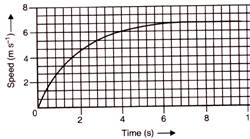
view answer >The speed-time graph for a car is shown here.
(a) Find how far does the car travel in the first 4 seconds. Shade the area on the graph that represents the distance travelled by the car during this period.
(b) Which part of the graph represents uniform motion of the car?
State which of the following situations are possible and give an example for each of these:
(a) An object with a constant acceleration but zero velocity.
(b) An object moving in a certain direction with an acceleration in the perpendicular direction.
view answer >An artificial satellite is moving in a circular orbit of radius 42250 km. Calculate its speed if it takes 24 hours to revolve around the earth.
view answer >