Solution of Chapter 4. Food Security in India (NCERT - Economics Book)
Chapter Exercises
Let's Discuss Pg-43
Study the following table and answer the questions given at the end of the table:
Year | Production (Lakh tonnes) | Imports (Lakh tonnes) | Export (Lakh tonnes) | Total availability(Lakh tonnes) |
1938 | 85 | - | - | 85 |
1939 | 79 | 04 | - | 83 |
1940 | 82 | 03 | - | 85 |
1941 | 68 | 02 | - | 70 |
1942 | 93 | - | 01 | 92 |
1943 | 76 | 03 | - | 79 |
Table: Production of Rice in the Province of Bengal
1. Some people say that the Bengal famine happened because there was a shortage of rice. Study the table and find out whether you agree with the statement.
2. Which year shows a drastic decline in food availability?
view answer >Let's Discuss Pg-45
Read the following descriptions and answer the questions that follow:
Story of Ramu
Ramu is a casual labourer in agriculture in Raipur village. He has a son named Somu who is 10 years old and he is the eldest one who also works as a pali to look after the cattle of the Sarpanch of the village Satpal Singh. Somu is paid Rs. 1000 per year for this work which is decided by the Sarpanch. Ramu has three more sons and two daughters but they can’t work because they are too young to work in a field. His wife Sunhari is also a part time worker who works as a cleaner for the livestock, removing and managing cow dung. There she gets 1/2 liter milk and some cooked food along with vegetables for her daily work. Sometimes she also helps his husband in field work to supplement his earnings. As we all know agriculture is a seasonal activity, so Ramu is employed during times of sowing, transplanting and harvesting but he remains unemployed for about 4 months during the time period of plant consolidation and maturing in a year. He looks for other works during this period to earn the livelihood. Sometimes he gets employed for construction work so somehow he is able to earn his livelihood which can meet his basic needs, to buy essentials and two square meals for his family. But during the days when he is unemployed he had to face a lot of complexities and even sometimes his kids have to sleep without food. Because of low income of the family milk and vegetables is luxury for them. He remains unemployed because of the seasonal nature of work.
1. Why is agriculture a seasonal activity?
2. Why is Ramu unemployed for about four months in a year?
3. What does Ramu do when he is unemployed?
4. What are supplementing income in Ramu’s family?
5. Why does Ramu face difficulty when he is unable to have work?
6. When is Ramu food insecure?
view answer >Read the following descriptions and answer the questions that follow:
Story of Ahmad
Ahmad is a rickshaw-puller in Bangalore. He has shifted from Jhumri Taliah along with his 3 brothers, 2 sisters and old parents. He stays in a jhuggi. The survival of all members of his family depends on his daily earnings from pulling rickshaw. However, he does not have a secured employment and his earnings fluctuate every day. During some days he gets enough earning for him to save some amount after buying all his day-to-day necessities. On other days, he barely earns enough to buy his daily necessities. However, fortunately, Ahmad has a yellow card, which is PDS Card for below poverty line people. With this card, Ahmad gets sufficient quantity of wheat, rice, sugar and kerosene oil for his daily use. He gets these essentials at half of the market price. He purchases his monthly stock during a particular day when the ration shop is opened for below poverty people. In this way, Ahmad is able to eke out his survival with less than sufficient earnings for his big family where he is the only earning member.
1. Does Ahmad have a regular income from rickshaw-pulling?
2. How does the yellow card help Ahmad run his family even with small earnings from rickshaw pulling?
view answer >Let's Discuss Pg-47
Study the graph and answer the following questions:
Production of Food grains in India (Million Tonnes)
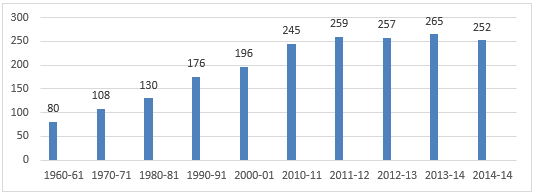
(a) In which year did our country cross the 200 million tonnes per year mark in food grain production?
(b) In which decade did India experience the highest decadal increase in food grain production?
(c) Is production increase consistent in India since 2000-2001?
view answer >Let's Discuss Pg-51
Study the Graph given below and answer the following questions:
Central Food grains (Wheat + Rice) Stock and Minimum Buffer Norm (Million Tonnes)
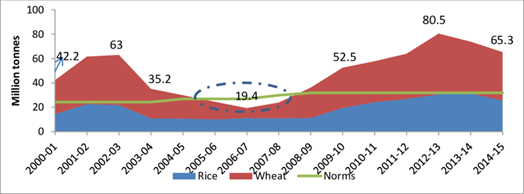
Study the graph above and answer the following questions:
1. In which recent year food grains stock with the government was maximum?
2. What is the minimum buffer stock norm for the FCI?
3. Why were the FCI granaries overflowing with food grains?
view answer >Exercise
How is food security secured in India?
view answer >Which are the people more prone to food insecurity?
view answer >Which states are more food insecure in India?
view answer >Do you believe that green revolution has made India self-sufficient in food grains?
view answer >A section of people in India is still without food. Explain.
view answer >What happens to the supply of food when there is a disaster or a calamity?
view answer >Differentiate between seasonal hunger and chronic hunger.
view answer >What has our government done to provide food security to the poor? Discuss any two schemes launched by the government.
view answer >Why is buffer stock created by the government?
view answer >Write notes on:
(a) Minimum support price
(b) Buffer stock
(c) Issue price
(d) Fair price shops
view answer >What are the problems of the functioning of the ration shops?
view answer >Write a note on the role of cooperatives in providing food and related items.
view answer >Suggested Activity Pg-44
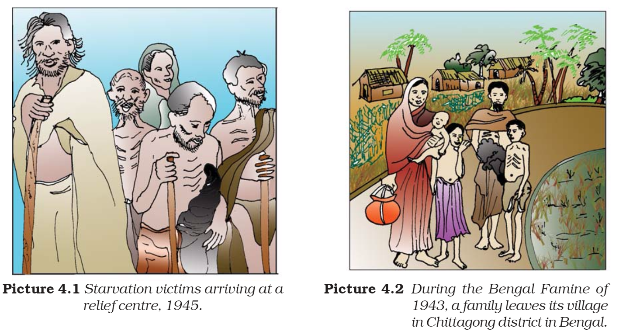
(a) What do you see in picture 4.1?
(b) Which age group is seen in the first picture?
(c) Can you say that the family shown in the picture 4.2 is a poor family? Why?
(d) Can you imagine the source of livelihood of the people, (shown in two pictures) before the occurrence of famine? (In the context of a village)
(e) Find out what type of help is given to the victims of natural calamity at a relief camp.
(f) Have you ever helped such victims (in the form of money, food, clothes, medicines etc.)?
view answer >Suggested Activity Pg-48
Visit your area's ration shop and get the following details:
1. When does the ration shop open?
2. What are the items sold at the ration shop?
3. Compare the prices of rice and sugar from the ration shop with the prices at any other grocery shop. (For families below poverty line)
4. Find out
(a) Do you have a ration card?
(b) What has your family recently bought with this card from the ration shop?
(c) Are there any problems that they face?
(d) Why are ration shops necessary?
view answer >Gather detailed information about some of the programmes initiated by the government, which have food components.
view answer >