Two identical prisms with right triangles as base are joined to form a rectangular prism as shown below:
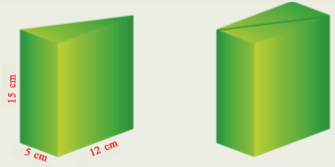
What is its total surface area?
Given: dimensions of triangular prism:
Height = 15cm
Smaller side of right triangular base = 5cm
bigger side of right triangular base = 12cm
To find: total surface area of the newly formed rectangular prism
Procedure:
After joining the 2 identical triangular prisms, we get a new rectangular prism.
⇒ The dimensions of the rectangular prism is:
Length of base = 12cm
Breadth of the base = 5cm
Height of the prism = 15cm
Now total surface area of the rectangular prism = lateral surface area + area of both the bases
We will have to find the lateral surface area of the rectangular prism.
⇒ Lateral surface area = base perimeter × height of prism
= (12+5) × 15
= 255cm2
∴ total surface area of the rectangular prism = 255 + 2× (12× 5)
= 255 + 120
= 375cm2
∴ Total surface area of the newly formed rectangular prism is 375cm2