In an experiment on photoelectric effect, the stopping potential is measured for monochromatic light beams corresponding to different wavelength. The data collected are as follows:
Plot the stopping potential against inverse of wavelength (1/λ) on a graph paper and find
(a) the Planck constant,
(b) the work function of the emitter and
(c) the threshold wavelength.
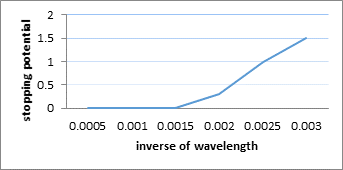
(a) from the given table ,
When λ = then V =1.45
∴ from Einstein’s photoelectric equation,
⇒  …..(1)
Again when λ= then V = 1
Then again the equation becomes  …… (2)
∴ subtracting eq (1) & (2) we get,
⇒ 
⇒ 
⇒ 
∴ Planck’s constant, 
(b) Substituting the values of h, c (speed of light),
We get the value of Ф (work function) as


∴ Work function, Ф =2.15eV.
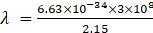
(c) We know that work function, 
Where λ is the threshold wavelength
h is the Planck’s constant
c is the speed of light
⇒