(a) Explain the meaning of the ‘‘Price Discrimination’’ feature under the monopoly form of market.
(b) Compare the nature of demand curves under monopoly and monopolistic competition.
A monopoly is a form of market where there is a single seller of a product called a monopolist. He has the full control over price, demand and supply decisions and thus uses this right to maximize his personal profit.
Under this aim of maximizing profit, the monopolist might often charge prices different from different consumers for the same product. This kind of practice of charging different prices for an identical product from different consumers is called Price Discrimination.
N.B. Other definitions:
1. Price Discrimination is charging different prices for the same product or same price for differentiated products. – Robinson.
2. Price Discrimination is the sale of various products at prices which are not proportional to their marginal costs. – Stigler.
3. Discriminatory monopoly means charging different rates from different consumers for the same good or service. – Dooley
4. Price discrimination refers strictly to the practice by a seller to charging different prices from different buyers for the same good – J.S. Bains
(b) A monopoly exists only when a person is the exclusive supplier of a good or service in the market. On the other hand, a monopolistic competition is a type of imperfect competition such that many producers sell products that are differentiated from one another.
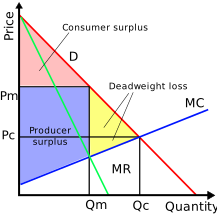
The difference in the nature of demand curves under monopoly and monopolistic competition is that the curve of the latter is more elastic. For a monopolistic competition, the demand curve slopes downwards. This signifies that the firms in this industry have market power. The firm can increase the price of its goods or services without having to lose all its customers.
For a monopoly, the nature of the curve is not as elastic as the monopolistic competition seller.
