Consider a capacitor-charging circuit. Let Q1 be the charge given to the capacitor in a time interval of 10 ms and Q2 be the charge given in the next time interval of 10ms. Let 10μC charge be deposited in a time interval t1 and the next 10 μC charge is deposited in the next time interval t2.
Formula used :
Charge of a capacitor is given by
Charge of a capacitor, 
Where
ε is the emf of a battery
C is the capacitance
R is the resistance of a resistor which is in series
T is the time period
charge developed on the capacitor in first interval of 10ms is
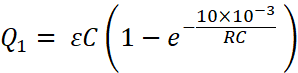
charge developed on the capacitor in first interval of 20ms is
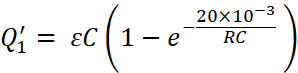
Charge developed on the capacitor in the interval 10ms to 20ms is



Compare  with
with 
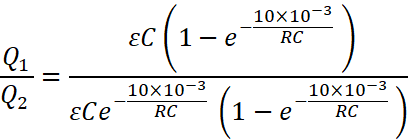

(Here  )
)

The time taking for 10μC to developed on the plates of capacitor is 

The time taking for 10μC to developed on the plates of capacitor 

Divide (1) by (2)
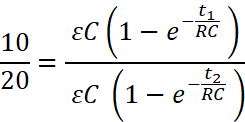

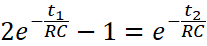
Take log on both sides
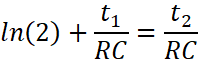

Q1 is the charge developed on the capacitor in a time interval of 10 ms and Q2 is the charge developed on the capacitor in the next time interval of 10ms. If a10μC charge be deposited in a time interval t1 and the next 10 μC charge is deposited in the next time interval t2. Then Q1 > Q2, t1 < t2. So option B is correct.