Figure (8-E12) shows two blocks A and B, each having a mass of 320 g connected by a light string passing over a smooth light pulley. The horizontal surface on which the block A can slide is smooth. The block A is attached to a spring of spring constant 40 N/m whose other end is fixed to a support 40 cm above the horizontal surface. Initially, the spring is vertical and unstretched when the system is released to move. Find the velocity of the block A at the instant it breaks off the surface below it. Take g = 10 m/s2.

The velocity of the block A is 
Given
The masses of the blocks are given as 320 g, the spring constant is given as 40 N/m, the block B is attached at a height of 40cm from the horizontal surface, with a gravity of .
.
Formula Used
The formula used to equate the conservation of the forces is given as Tension/Force equal to the product of spring constant/mass with compression distance/gravity.


where
T is the tension, k is the spring constant, m is the mass, x is the compression distance and g is the gravity.
Explanation
The formula used is the force or the tension, applied on the block A due to spring is given as

where X is taken as  , so the tension due to spring is

By equating the y-axis direction of the  force is

Placing the tension as , we get the equation as




Now finding the value of the displacement x, we get the value as


Hence, the difference in Kinetic Energy is equivalent to the force applied on the block is written as
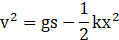
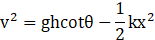


Therefore, the velocity of the block A is 