Verify Lagrange’s mean value theorem for the following functions on the indicated intervals. In each find a point ‘c’ in the indicated interval as stated by the Lagrange’s mean value theorem :

Lagrange’s mean value theorem states that if a function f(x) is continuous on a closed interval [a, b] and differentiable on the open interval (a, b), then there is at least one point x=c on this interval, such that
f(b)−f(a)=f′(c)(b−a)
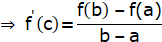
This theorem is also known as First Mean Value Theorem.

Here,

⇒ x2 – 4 >0
⇒ x2 > 4
⇒ f(x) exists for all values expect ( – 2, 2)
∴ f(x) is continuous in [2, 4]

Differentiating with respect to x:
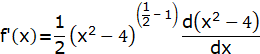

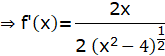
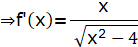
Here also,

⇒ f’(x) exists for all values of x except (2, – 2)
∴ f(x) is differentiable in (2, 4)
So both the necessary conditions of Lagrange’s mean value theorem is satisfied.


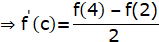

On differentiating with respect to x:
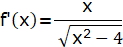
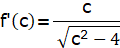
For f’(c), put the value of x=c in f’(x):
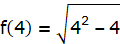
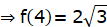
For f(4), put the value of x=4 in f(x):


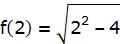
For f(2), put the value of x=2 in f(x):
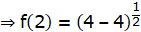
⇒ f(2) = 0


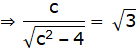

Squaring both sides:

⇒ c2 = 3(c2 – 4)
⇒ c2 = 3c2 – 12
⇒ – 2c2 = – 12

⇒ c2 = 6


Hence, Lagrange’s mean value theorem is verified.