Find the sum of the following series to infinity :

We observe that above progression possess a common ratio, but alternatively , adjacent terms are not possessing a common ratio. So, it consists of 2 geometric progressions.
Let, S = 
⇒ S = 
Let us denote the two progressions with S1 and S2
∴ S = S1 + S2
S1 = 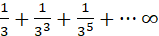
Common ratio = r = 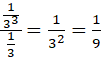
Sum of infinite GP =  ,where a is the first term and r is the common ratio.
Note: We can only use the above formula if |r|<1
Clearly, a =  and r = 1/9
⇒ S1 = 
S2 = 
Common ratio = r = 
Sum of infinite GP =  ,where a is the first term and r is the common ratio.
Note: We can only use the above formula if |r|<1
Clearly, a =  and r = 1/25
⇒ S2 = 
Hence,
S = 
1