Differentiate the following from first principles

We need to find derivative of f(x) = 
Derivative of a function f(x) is given by –
f’(x) = 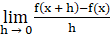 {where h is a very small positive number}
∴ derivative of f(x) =  is given as –
f’(x) = 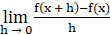
⇒ f’(x) = 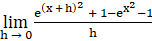
⇒ f’(x) = 
Taking  common, we have –
⇒ f’(x) = 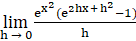
Using algebra of limits –
⇒ f’(x) = 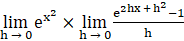
⇒ f’(x) = 
As one of the limits 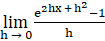 can’t be evaluated by directly putting the value of h as it will take 0/0 form.
So we need to take steps to find its value.
As h → 0 so, (2hx + h2) → 0
∴ multiplying numerator and denominator by (2hx + h2) in order to apply the formula – 
∴ f’(x) = 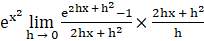
Again using algebra of limits, we have –
⇒ f’(x) = 
Use the formula: 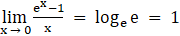
⇒ f’(x) = 
⇒ f’(x) = 
∴ f’(x) = 
Hence,
Derivative of f(x) = 
3