(i) Derive an expression for drift velocity of free electrons.
(ii) How does drift velocity of electrons in a metallic conductor vary with increase in temperature? Explain.
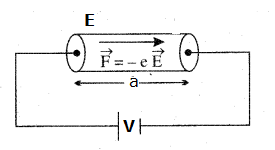
(i) First, We suppose a conductor with an electric field E. Let a free electron experience a force (-eE) in the electric field. Thus, the acceleration of free electron can be written as:

 ………(1)
Where,
E is the electric field as shown in the figure,
‘e’ is the charge on an electron
‘m’ is the mass of the electron.
Thus, the velocity of the free charge carrier .i.e. electron in time interval t1 is,
v1 = u1 + at1 ……..(2)
where,
v1 is the final velocity of the electron after time interval t1
The final velocities for the n charge carriers is supposed to be v2, v3, …. vn. The average velocity or the drift velocity (vd) of the free electrons thus is,
vd = (v1 + v2 + v3…. + vn)/ n
we put the values of final velocity from (2) to get,
⇒ vd = (u1 + at1 + u2 + at2……..un + atn) / n
⇒ vd = [(u1 + u2 + ….un) + a(t1 + t2 + …..tn)] / n
We also know that the electrons were initially at rest, the average initial velocity is thus zero.
⇒ (u1 + u2 + ….un)n = 0
And the total average time taken between two consecutive collisions = (t1 + t2 + t3….. + t4) /n = τ
Where,
τ is defiend as the relaxation time.
and
vd = at
putting the value from (1) we get,
⇒ vd = 
This is the required drift velocity.
(ii) The drift velocity of free electrons in a metallic conductor is inversely proportional to the temperature, it decreases with the increases in temperature as in the metallic conductor the collision between the electrons and ions increases with the increase in the temperature, thus decreasing the relaxation time. Therefore, the drift velocity decreases.