Solution of Chapter 2. Microorganisms : Friend and Foe (NCERT Science Exemplar Book)
Chapter Exercises
Multiple Choice Questions
Which of the following reproduces only inside a host cell?
view answer >A Disease in human beings caused by virus is________.
view answer >Pathogenic micro-organism present in a host cell are killed by medicines called
view answer >The two micro-organism which live in symbiotic association in lichens are
view answer >The gas released during the preparation of bread is
view answer >The disease caused by a protozon and spread by an insect is________.
view answer >Paheli dug two pits, A and B, in her garden. In pit A, she put a polythene bag packed with some agriculture waste. In pit B, she dumped the same kind of a waste but without packing it in a polythene bag. She then covered both the pits with soil. What did she observe after a month?
view answer >Very Short Answer Type
Unscramble the jumbled words underlined in the following statements.
(a) cells of our body produce antidote fight pathogens.
(b) curbossulite is an air-borne disease caused by a bacterium.
(c) Xanrhat is a dangerous bacterial disease.
(d) Yeasts are used in the wine industry because of their property of meronettinaf.
view answer >Suggest a suitable word for each of the following statements.
(a) Chemicals added to food to prevent the growth of the microorganism.
(b) Nitrogen-fixing micro-organisms present in the root nodules of legumes.
(c) Agents which spread pathogens from one place to another.
(d) Chemicals which kill or stop the growth of pathogens.
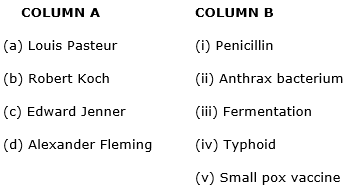
view answer >Match the names of the scientist given in COLUMN A with the discovery made by them given in COLUMN B.
Name one commercial use of yeast.
view answer >Name the process in yeast that converts sugar into alcohol.
view answer >In the soil, which nutrients are enriched by blue-green algae (cyanobacterial)?
view answer >Why should we avoid standing close to a tuberculosis patient while he/she is coughing?
view answer >Polio drops are not given to children suffering from diarrhoea. Why?
view answer >Paheli watched her grandmother making mango pickle. After she bottled the pickle, her grandmother poured oil on the top of the pickle before closing the lid. Paheli wanted to know why oil was poured? Can you help her understand why?
view answer >Short Answer Type
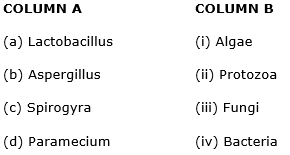
Match the following given in COLUMN A to the group to which they belong in COLUMN B.
Classify the following into friendly and harmful microorganisms.
Yeasts, malaria parasite, Lactobacillus, bread mould, Rhizobium, Bacillus anthracis

While returning from the school. Boojho ate chaat from a street hawker. When he reached home, he felt ill and complained of stomach ache and fell ill. What could be the reason?
view answer >What will happen to 'pooris' and 'unused kneaded flour' if they are left in the open for a day or two?
view answer >(a) Name two diseases that are caused by a virus.
(b) Write one important characteristic of the virus.
view answer >Long Answer Type
Observe the Fig.2.1 and answer the questions that follows.
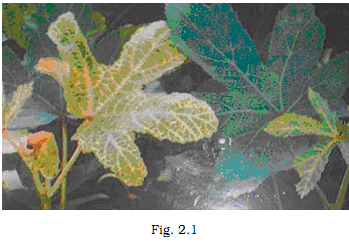
(a) Write the names of the disease.
(b) Name the causative agent of this disease?
(c) How does the disease spread from one plant to another?
(d) Name any two plant diseases and the microbes that cause them.
view answer >How do vaccines work?
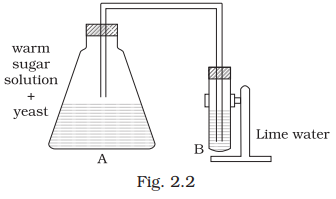
view answer >Observe the set up given in Fig.2.2 and answer the following questions.
(a) What happens to the sugar solution in A?
(b) Which gas is released in A?
(c) What changes will you observe in B when the released gas passes through it?
Observe the Fig.2.3 and answer the following questions.
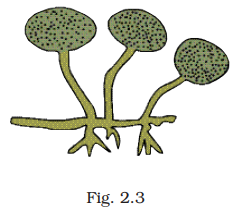
(a) Name the microorganism and the group to which it belongs.
(b) Name the food item on which the organism grows.
(c) Does it grow well in dry or in moist conditions?
(d) Is it safe to eat infected bread?
view answer >Give reasons for the following.
(a) Fresh milk is boiled before consumption while processed milk stored in packets can be consumed without boiling.
(b) Raw vegetables and fruits are kept in refrigerator whereas jams and pickles can be kept outside.
(c) Farmers prefer to grow beans and peas in nitrogen deficient soils.
(d) Mosquitoes can be controlled by preventing stagnation of water through they do not live in water. Why?
view answer >How can we prevent the following diseases?
(a) Cholera
(b) Typhoid
(c) Hepatitis A
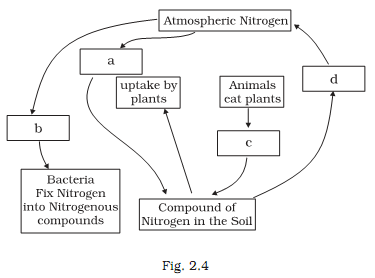
view answer >Complete the following cycle given as Fig.2.4 by filling the blanks (a), (b), (c), (d).