Solution of Chapter 2. Polynomials (NCERT - Exemplar Mathematics Book)
Chapter Exercises
Exercise 2.1
If one of the zeroes of the quadratic polynomial (k - 1) x2 + kx + 1 is - 3, then the value of k is
view answer >A quadratic polynomial, whose zeros are - 3 and 4, is
view answer >If the zeros of the quadratic polynomial x2 + (a + 1)x + b are 2 and - 3,
Then
view answer >The number of polynomials having zeroes as - 2 and 5 is
view answer >If one of the zeroes of the cubic polynomial ax3 + bx2 + cx + d is zero, the product of the other two zeroes is
view answer >If one of the zeroes of the cubic polynomial x3 + ax2 + bx + c is - 1, then the product of the other two zeroes is
view answer >The zeroes of the quadratic polynomial x2 + 99x + 127 are
view answer >The zeroes of the quadratic polynomial x2 + kx + k where k≠0,
view answer >If the zeroes of the quadratic polynomial ax2 + bx + c, where c≠0, are equal, then
view answer >If one of the zeroes of a quadratic polynomial of the form x2 + ax + b is the negative of the other, then it
view answer >Which of the following is not the graph of a quadratic polynomial?
view answer >Exercise 2.2
Can x2 - 1 be the quotient on division of x6 + 2x3 + x - 1 by a polynomial in x of degree 5?
view answer >What will the quotient and remainder be on division of ax2 + bx + c by px3 + qx2 + rx + s, p≠0?
view answer >If on division of a polynomial p(x) by a polynomial g(x), the quotient is zero, what is the relation between the degree of p (x) and g(x)?
view answer >If on division of a non - zero polynomial p(x) by a polynomial g(x), the remainder is zero, what is the relation between the degree of p (x) and g (x)?
view answer >Can the quadratic polynomial x2 + kx + k have equal zeroes for some odd integer k > 1?
view answer >Are the following statements ‘true’ or ‘False’? Justify your answer.
If the zeroes of a quadratic polynomial ax2 + bx + c are both positive, then a, b and c all have the same sign.
view answer >Are the following statements ‘true’ or ‘False’? Justify your answer.
If the graph of a polynomial intersects the x - axis at only one point it need not be a quadratic polynomial.
view answer >Are the following statements ‘true’ or ‘False’? Justify your answer.
If the graph of a polynomial intersects the x - axis at exactly two points, it need not be a quadratic polynomial.
view answer >Are the following statements ‘true’ or ‘False’? Justify your answer.
If two of the zeroes of cubic polynomials are zero then it does not have linear and constant terms.
view answer >Are the following statements ‘true’ or ‘False’? Justify your answer.
If all the zeroes of a cubic polynomial are negative, then all the coefficients and the constant term of the polynomial have the same sign.
view answer >Are the following statements ‘true’ or ‘False’? Justify your answer.
If all three zeroes of a cubic polynomial x3 + qx2 - bx + c are positive, then at least one of a, b and c is non - negative.
view answer >Are the following statements ‘true’ or ‘False’? Justify your answer.
The only value of k for which the quadratic polynomial kx2 + x + k has equal zeroes is 1/2
view answer >Exercise 2.3
4x2 - 3x - 1.
view answer >3x2 + 4x - 4.
view answer >5t2 + 12t + 7.
view answer >t3 - 2t2 - 15t.
view answer >2x2 + 7/2 x + 3/4.
view answer >4x2 + 52x - 3.
view answer >2s2 - (1 + 22)s + 2.
view answer >v2 + 43v - 15.
view answer >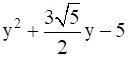 .
.
7y2 - 11y/3 - 2/3.
view answer >Exercise 2.4
For each of the following, find a quadratic polynomial whose sum and product respectively of the zeroes are as given. Also, find the zeroes of these polynomials by factorization.

For each of the following, find a quadratic polynomial whose sum and product respectively of the zeroes are as given. Also, find the zeroes of these polynomials by factorization.

For each of the following, find a quadratic polynomial whose sum and product respectively of the zeroes are as given. Also, find the zeroes of these polynomials by factorization.
- 23, - 9
view answer >For each of the following, find a quadratic polynomial whose sum and product respectively of the zeroes are as given. Also, find the zeroes of these polynomials by factorization.

If the zeroes of the cubic polynomial x3 - 6x2 + 10 are of the form a, a + b and a + 2b for some real numbers a and b, find the values of a and b as well as the zeroes of the given polynomial.
view answer >If √2 is zero of the cubic polynomial 6x3 + 2x2 - 10x - 42, the find it’s other two zeroes.
view answer >Find k, so that x2 + 2x + k is a factor of 2x4 + x3 - 14x2 + 5x + 6. Also, find all the zeroes of the two polynomials.
view answer >If x - 5 is a factor of the cubic polynomial x3 - 35x2 + 13x - 35, then find all the zeroes of the polynomial.
view answer >For which values of a and b, the zeroes of q (x) = x3 + 2x2 + a are also the zeros of the polynomial p(x) = x5 - x4 - 4x3 + 3x + b? Which zeroes of p(x) are not the zeroes of p (x)?
view answer >