Solution of Chapter 7. Coordinate Geometry (NCERT - Mathematics Book)
Chapter Exercises
Exercise 7.1
Find the distance between the following pairs of points:
(i) (2, 3), (4, 1)
(ii) (– 5, 7), (– 1, 3)
(iii) (a, b), (– a, – b)
view answer >Find the distance between the points (0, 0) and (36, 15). Can you now find the distancebetween the two towns A and B discussed in Section 7.2
view answer >Determine if the points (1, 5), (2, 3) and (– 2, – 11) are collinear
view answer >Check whether (5, – 2), (6, 4) and (7, – 2) are the vertices of an isosceles triangle
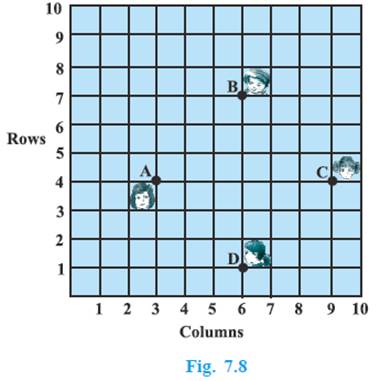
view answer >In a classroom, 4 friends areseated at the points A, B, C and D as shown in Fig. 7.8 Champaand Chameli walk into the classand after observing for a fewminutes Champa asks Chameli,“Don’t you think ABCD is asquare?” Chameli disagrees.Using distance formula, findwhich of them is correct
Name the type of quadrilateralformed, if any, by the followingpoints, and give reasons foryour answer:
(i) (– 1, – 2), (1, 0), (– 1, 2), (– 3, 0)
(ii) (–3, 5), (3, 1), (0, 3), (–1, – 4)
(iii) (4, 5), (7, 6), (4, 3), (1, 2)
view answer >Find the point on the x-axis which is equidistant from (2, –5) and (–2, 9)
view answer >Find the values of y for which the distance between the points P(2, – 3) and Q (10, y) is10 units
view answer >If Q(0, 1) is equidistant from P(5, –3) and R(x, 6), find the values of x. Also find the distances QR and PR
view answer >Find a relation between x and y such that the point (x, y) is equidistant from the point (3, 6) and (– 3, 4)
view answer >Exercise 7.2
Find the coordinates of the point which divides the join of (–1, 7) and (4, –3) in the ratio 2: 3
view answer >Find the coordinates of the points of trisection of the line segment joining (4,–1) and (–2, –3)
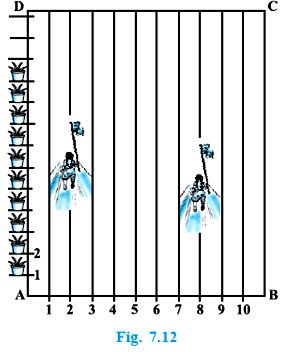
view answer >To conduct Sports Day activities, in your rectangular shaped school ground ABCD, lines have been drawn with chalk powder at a distance of 1m each. 100 flower pots have been placed at a distance of 1m from each other along AD, as shown in Fig. 7.12. Niharika runs  th thedistance AD on the 2nd line andposts a green flag. Preet runs
 ththe distance AD on the eighth lineand posts a red flag. What is thedistance between both the flags? IfRashmi has to post a blue flag exactlyhalfway between the line segmentjoining the two flags, where shouldshe post her flag?
Find the ratio in which the line segment joining the points (– 3, 10) and (6, – 8) is divided by (– 1, 6)
view answer >Find the ratio in which the line segment joining A(1, – 5) and B(– 4, 5) is divided by thex-axis. Also find the coordinates of the point of division
view answer >If (1, 2), (4, y), (x, 6) and (3, 5) are the vertices of a parallelogram taken in order, find x and y
view answer >Find the coordinates of a point A, where AB is the diameter of a circle whose centre is (2, – 3) and B is (1, 4)
view answer >If A and B are (– 2, – 2) and (2, – 4), respectively, find the coordinates of P such that and P lies on the line segment AB
Find the coordinates of the points which divide the line segment joining A(– 2, 2) andB (2, 8) into four equal parts
view answer >Find the area of a rhombus if its vertices are (3, 0), (4, 5), (– 1, 4) and (– 2, – 1) taken inorder. [Hint: Area of a rhombus  (product of its diagonals)]
Exercise 7.3
Find the area of the triangle whose vertices are:
(i) (2, 3), (–1, 0), (2, – 4)
(ii) (–5, –1), (3, –5), (5, 2)
view answer >In each of the following find the value of ‘k’, for which the points are collinear
(i) (7, –2), (5, 1), (3, k)
(ii) (8, 1), (k, – 4), (2, –5)
view answer >Find the area of the triangle formed by joining the mid-points of the sides of the trianglewhose vertices are (0, –1), (2, 1) and (0, 3). Find the ratio of this area to the area of the given triangle
view answer >Find the area of the quadrilateral whose vertices, taken in order, are (– 4, – 2),
(–3, – 5), (3, – 2) and (2, 3)
You have studied in Class IX, (Chapter 9, Example 3), that a median of a triangle dividesit into two triangles of equal areas. Verify this result for Δ ABC whose vertices areA(4, – 6), B(3, –2) and C (5, 2)
view answer >Exercise 7.4
Determine the ratio in which the line 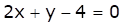 divides the line segment joining the points A (2, – 2) and B (3, 7)
Find a relation between x and y if the points (x, y), (1, 2) and (7, 0) are collinear
view answer >Find the centre of a circle passing through the points (6, – 6), (3, – 7) and (3, 3)
view answer >The two opposite vertices of a square are (–1, 2) and (3, 2). Find the coordinates of the other two vertices
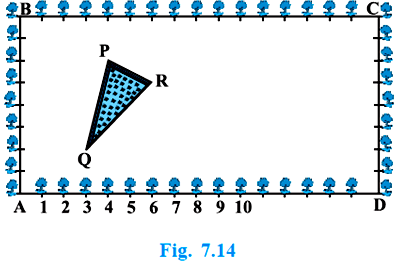
view answer >The Class X students of asecondary school inKrishinagarhave been allotteda rectangular plot of land fortheir gardening activity.Sapling of Gulmohar areplanted on the boundary at adistance of 1m from each other.There is a triangular grassylawn in the plot as shown inthe Fig. 7.14. The students areto sow seeds of floweringplants on the remaining area of the plot
(i) Taking A as origin, find the coordinates of the vertices of the triangle.
(ii) What will be the coordinates of the vertices of Δ PQR if C is the origin?
Also calculate the areas of the triangles in these cases. What do you observe?
The vertices of a Δ ABC are A(4, 6), B(1, 5) and C(7, 2). A line is drawn to intersect sides AB and AC at D and E respectively, such that 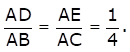 Calculate the area of theΔ ADE and compare it with the area of Δ ABC (Recall Theorem 6.2 and Theorem 6.6)
Let A (4, 2), B(6, 5) and C (1, 4) be the vertices of Δ ABC
(i) The median from A meets BC at D. Find the coordinates of the point D
(ii) Find the coordinates of the point P on AD such that AP: PD = 2: 1
(iii) Find the coordinates of points Q and R on medians BE and CF respectively such that BQ: QE = 2: 1 and CR: RF = 2: 1
(iv) What do you observe?
[Note: The point which is common to all the three medians is called the centroidand this point divides each median in the ratio 2: 1]
(v) If 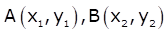 and
and  are the vertices of Δ ABC, find the coordinates of the centroid of the triangle
ABCD is a rectangle formed by the points A(–1, –1), B(– 1, 4), C(5, 4) and D(5, – 1). P, Q,R and S are the mid-points of AB, BC, CD and DA respectively. Is the quadrilateralPQRS a square? a rectangle? or a rhombus? Justify your answer
view answer >