Solution of Chapter 5. Complex numbers and quadratic equations (Mathematics Book)
Chapter Exercises
Exercise 5.1
Express each of the complex number given in the Exercises 1 to 10 in the form a + ib.
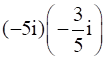
Express each of the complex number given in the Exercises 1 to 10 in the form a + ib.
i9 + i19
view answer >Express each of the complex number given in the Exercises 1 to 10 in the form a + ib.
i–39
view answer >Express each of the complex number given in the Exercises 1 to 10 in the form a + ib.
3(7 + i7) + i(7 + i7)
view answer >Express each of the complex number given in the Exercises 1 to 10 in the form a + ib.
(1-i) – (-1 + i6)
view answer >Express each of the complex number given in the Exercises 1 to 10 in the form a + ib.
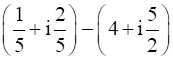 .
.
Express each of the complex number given in the Exercises 1 to 10 in the form a + ib.

Express each of the complex number given in the Exercises 1 to 10 in the form a + ib.
(1 – i)4
view answer >Express each of the complex number given in the Exercises 1 to 10 in the form a + ib.

Express each of the complex number given in the Exercises 1 to 10 in the form a + ib.

Find the multiplicative inverse of the complex number (4-3i)
view answer >Find the multiplicative inverse of √5 + 3i
view answer >Find the multiplicative inverse of –i
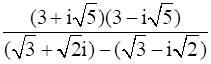
view answer >Express the following expression in the form of a + ib:
Exercise 5.2
Find the modulus and the arguments of each of the complex numbers in Exercises 1 to 2.
z = –1 – i√ 3
view answer >Find the modulus and the arguments of each of the complex numbers in Exercises 1 to 2.
z = – √3 + i
view answer >Convert each of the complex numbers given in Exercises 3 to 8 in the polar form:
1 – i
view answer >Convert each of the complex numbers given in Exercises 3 to 8 in the polar form:
– 1 + i
view answer >Convert each of the complex numbers given in Exercises 3 to 8 in the polar form:
– 1 – i
view answer >Convert each of the complex numbers given in Exercises 3 to 8 in the polar form:
– 3
view answer >Convert each of the complex numbers given in Exercises 3 to 8 in the polar form:
√2 + i
view answer >Convert each of the complex numbers given in Exercises 3 to 8 in the polar form:
i
view answer >Miscellaneous Exercise
Evaluate: 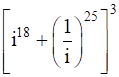
For any two complex numbers z1 and z2, prove that
Re (z1 z2) = Re z1 Re z2 – Imz1 IMz2
view answer >Reduce 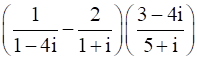 to the standard form.
If 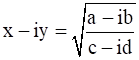 prove that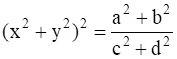
Convert the following in the polar form:

Convert the following in the polar form:

Solve each of the equation in Exercises 6 to 9:
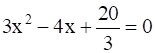
Solve each of the equation in Exercises 6 to 9:
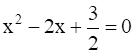
Solve each of the equation in Exercises 6 to 9:
27x2 – 10 x + 1 = 0
view answer >Solve each of the equation in Exercises 6 to 9:
21x2 − 28x + 10 = 0
view answer >If z1 = 2 – i, z2 = 1 + i, find 
If 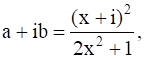 prove that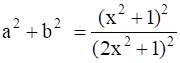
Let z1 = 2 – i, z2 = –2 + i. Find:
(i) 
(ii) 
Find the modulus and argument of the complex number 
Find the real numbers x and y if (x – iy) (3 + 5i) is the conjugate of –6 – 24i
view answer >Find the modulus of 
If (x + iy)3 – u + iv, then show that: 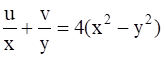
If α and β are different complex numbers with |β| = 1 , then find 
Find the number of non-zero integral solutions of the equation |1 – i|x = 2x
view answer >If (a + ib) (c + id) (e + if) (g + ih) = A + iB, then show that:
(a2 + b2) (c2 + d2) (e2 + f2) (g2 + h2) = A2 + B2
view answer >If 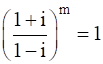 , then find the least positive integral value of m.
Exercise 5.3
Solve each of the following equations:
x2 + 3 = 0
view answer >Solve each of the following equations:
2x2 + x + 1 = 0
view answer >Solve each of the following equations:
x2 + 3x + 9 = 0
view answer >Solve each of the following equations:
– x2 + x – 2 = 0
view answer >Solve each of the following equations:
x2 + 3x + 5 = 0
view answer >Solve each of the following equations:
x2 – x + 2 = 0
view answer >Solve each of the following equations:
√2x2 + x + √2 = 0
view answer >Solve each of the following equations:
√3x2 – √2x + 3√3 = 0
view answer >Solve each of the following equations:
x2 + x + 1/√2 = 0
view answer >Solve each of the following equations:
x2 + x/√2 + 1 = 0
view answer >