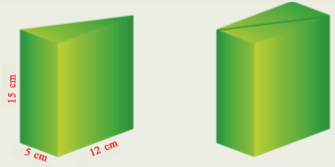
The base of a prism is an equilateral triangle of perimeter 12 centimetres and its height is 5 centimetres. What is its total surface area?
Given: base of a prism is an equilateral triangle and its perimeter “p” = 12cm
Height of the prism “h” = 5cm
To find : total surface area of the prism = ?

Procedure :
Now, we know that,
total surface area of the prism = lateral surface area of the prism + 2× (area of base of the prism)
⇒ first we will find the side of the triangular base of the prism.
So, perimeter of the equilateral triangle = 3×side
⇒ 12 = 3×side
⇒ Side = 4cm
now, to find the lateral surface area, we have
⇒ Lateral surface area =perimeter of base of prism × height of prism
= 12 × 5
= 60cm2
Now, we can find the total surface area of the prism.
So, total surface area of the prism = lateral surface area of the prism + 2× (area of base of the prism)
⇒ total surface area of the prism = 60 + 2×(area of equilateral triangle)
⇒ total surface area of the prism = 60 + 2×( × side2)
= 60 + 2× ( ×42)
×42)
= 60 + 8√3
= 60 + 13.856
= 73.856cm2
∴ Total surface area of the given prism is 73.856cm2
Couldn't generate an explanation.
Generated by AI. May contain inaccuracies — always verify with your textbook.