
Find the angles made by the following vectors with the coordinate axes:
(i) 
(ii) 
(iii) 
(i) The angle between the two lines is given by
cos =
= 
where R1 and R2 denote the vectors with the direction ratios,
So, here we have,
R1 = i - j + k and R2 = i for x- axis
cos =
= 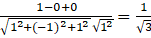
cos
Hence, 
With y- axis, i. e. R2 = j
cos =
= 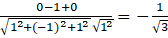
cos
Hence, 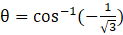
With z- axis, i. e. R2 = k
cos =
= 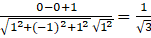
cos
Hence, 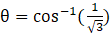
(ii) The angle between the two lines is given by
cos =
= 
where R1 and R2 denote the vectors with the direction ratios,
So, here we have,
R1 = j - k and R2 = i for x- axis
cos =
= 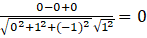
cos
Hence, 
With y- axis, i. e. R2 = j
cos =
= 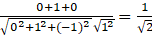
cos
Hence, 
With z- axis, i. e. R2 = k
cos =
= 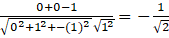
cos
Hence, 
(iii) The angle between the two lines is given by
cos =
= 
where R1 and R2 denote the vectors with the direction ratios,
So, here we have,
R1 = i - 4j + 8k and R2 = i for x- axis
cos =
= 
cos
Hence, 
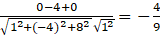
With y- axis, i. e. R2 = j
cos =
= 
cos
Hence, 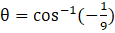
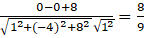
With z- axis, i. e. R2 = k
cos =
= 
cos
Hence, 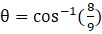
Couldn't generate an explanation.
Generated by AI. May contain inaccuracies — always verify with your textbook.


