Q30 of 30 Page 1

(a) What is an electromagnet? List any two uses.

(b) Draw a labelled diagram to show how an electromagnet is made.


(c) State the purpose of soft iron core used in making an electromagnet.


(d) List two ways of increasing the strength of an electromagnet if the material of the electromagnet is fixed.


(a) Electromagnet is a device which is used to generate magnetism when electric current is passed through it. It can be made by winding conducting wire around the core.

Uses:


1. In magnetic latches


2. Used in cranes for lifting metallic objects


(b)
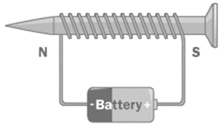


(c) Soft iron core is used in electromagnet to increase its magnetic strength.


(d) The strength of the electromagnet can be increased by:


1. Increase the number of turns of the coil.


2. By increasing the magnitude of current.


More from this chapter

All 30 →
26

The position of certain elements in the Modern Periodic Table are shown below.

Using the above table answer following questions giving reasons in each case :


(i) Which element will form only covalent compounds?


(ii) Which element is a non-metal with valency 2 ?


(iii) Which element is a metal with valency 2 ?


(iv) Out of H, C and F which has largest atomic size?


(v) To which family does H, C and F belong?


OR


Define atomic size. Give its unit of measurement. In the modern periodic table what trend is observed in the atomic radius in a group and a period and why is it so?


27

(a) Why is there a difference in the rate of breathing between aquatic organisms and terrestrial organisms? Explain.

(b) Draw a diagram of human respiratory system and label – pharynx, trachea, lungs, diaphragm and alveolar sac on it.


OR


(a) Name the organs that form the excretory system in human beings.


(b) Describe in brief how urine is produced in human body.


28

(a) What is the law of dominance of traits? Explain with an example.

(b) Why are the traits acquired during the life time of an individual not inherited? Explain.


29

Draw a ray diagram in each of the following cases to show the formation of image, when the object is placed:

(i) between optical centre and principal focus of a convex lens.


(ii) anywhere in front of a concave lens.


(iii) at 2 F of a convex lens. State the signs and values of magnifications in the above-mentioned cases (i) and (ii).


OR


An object 4.0 cm in size, is placed 25.0 cm in front of a concave mirror of focal length 15.0 cm


(i) At what distance from the mirror should a screen be placed in order to obtain a sharp image?


(ii) Find the size of the image.


(iii) Draw a ray diagram to show the formation of image in this case.