Q4 of 20 Page 63

Give two example of the following in the space provided.

(i) Raw Materials: …………and ……………..


(ii) End Products: …………and…………


(iii) Tertiary Activities: ………..and……….


(iv) Agro-based Industries: …………..and……


(v) Cottage Industries: ………and……….


(vi) Co-operatives:…………and…….

(i) Iron ore, cotton (Iron ore is used as a raw material for Iron and Steel Industry and Cotton is used as a raw material for Cotton Textile Industry)

(ii) Cotton cloth, Spear and hammer (Cotton cloth is the end product that comes out of cotton textile industry. Iron processed in Iron and Steel industry is used for making spear and hammer.)


(iii) Commerce, Banking (Tertiary sector is known as the service sector of economy. Tertiary sector provides services instead of products.)


(iv) Food processing, Cotton textile (Agro based industries are those industries whose raw materials come from agriculture. Food processing industries use plants, vegetables and fruits all of which comes from different forms of agriculture. Cotton textile industry uses raw cotton as its raw material which also comes through agriculture.)


(v) Basket weaving, pottery (Cottage industries are low scale or village based industries. Such industries are operated by people out of their own homes. The raw materials used are fairly simple and there is minimal use of machineries.)


(vi) Amul, Mother Dairy (A co-operative is an organization which is run in partnership by its members. Costs and profits are shared by each member.)


More from this chapter

All 20 →
3

Distinguish between the following:

Agro-based and mineral-based industry

3

Distinguish between the following:

Public sector and joint sector industry

5

How to identify a location for establishing an industry?

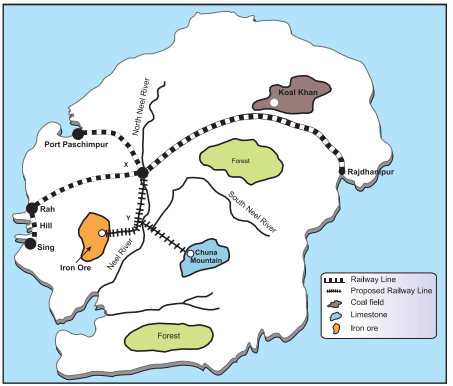
Divide your class into groups. Each group is a Board of Directors faced with the problem of choosing suitable site for an iron and steel plant Developed Dweep. A team of technical experts have submitted a report with notes and a map. The team considered access to iron-ore, coal, water and limestone, as well as the main market, sources of labour and port facilities. The team has suggested two sites, X and Y. the Board of Directors has to take the final decision about where to locate the steel plant.


Read the report submitted by the team.


● Study the map to find out the distances of the resources from each site.


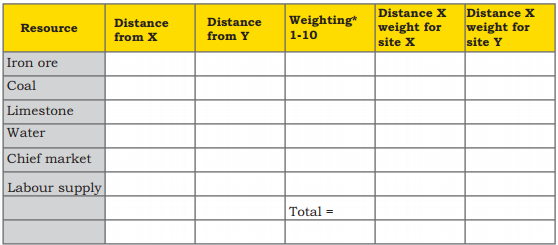
● Give each resources a “weight” from 1 to 10 according to its importance. The greater the ‘pull’ of the factor on the industry, the higher the weight from 1 to 10.


● Complete the table.


● The site with the lowest total should be the most satisfactory site.


● Remember each group of directors can decide differently.

1

Factors/Resources affecting the location of a proposed Iron and Steel Plant on developed Dweep.

● Iron-ore: There are very large deposits of low grade iron-ore in India. Long distance transportation of the ore would be uneconomic.


● Coal: The only coal field contains rich deposits of high grade coal. vTransportation of the coal is by railway, which is relatively cheap.


● Limestone: This is widely available over the island, but the purest deposits are in the Chuna mountains.


● Water: Both the tributaries of river Neel carry sufficient water to supply a large iron and steel plant in all seasons. The sea water, because of its high salt content is unsuitable.


● Market: It is expected that the chief market for the engineering works of Rajdhanipur. Transports for the products mainly small steel bars and light steel plates would be relatively low.


● Labour Supply: This will have to be recruited mainly from the unskilled workers in the 3 fishing villages of Hill, Rah and Sing. It is expected that most workers will commute daily from their present homes.


● Port Facilities: These are at present minimal. There is a good, deep natural harbor at port Pashimpuri developed to import metal alloys.