Q38 of 44 Page 17

Classify each of the following, as a physical or a chemical change. Give reasons.

(a) Drying of a shirt in the sun.


(b) Rising of hot air over a radiator.


(c) Burning of kerosene in a lantern.


(d) Change in the colour of black tea on adding lemon juice to it.


(e) Churning of milk cream to get butter.

(a) Drying of a shirt in the sun is a physical change because evaporation of water takes place but no change occurs in the composition of the substance.
(b) Rising of hot air over a radiator is a physical change because it is involving the only movement of air, no change in the composition of air.
(c) Burning of kerosene in a lantern is a chemical change because kerosene burns to form carbon dioxide and water vapour.
(d) Change in the colour of black tea on adding lemon juice to it is a chemical change as a new substance with chemical properties are formed.
(e) Churning of milk cream to get butter is a physical change as there is no change in composition. Only the separation of components takes place by the physical phenomenon called centrifugation.


More from this chapter

All 44 →
36

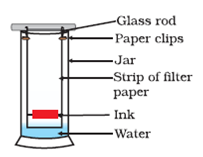
A child wanted to separate the mixture of dyes constituting a sample of ink. He marked a line by the ink on the filter paper and placed the filter paper in a glass containing water as shown in Fig. 2.3. The filter paper was removed when the water moved near the top of the filter paper.

(a) What would you expect to see, if the ink contains three different coloured components?


(b) Name the technique used by the child.


(c) Suggest one more application of this technique.


37

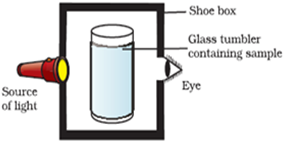
A group of students took an old shoe box and covered it with a black paper from all sides. They fixed a source of light (a torch) at one end of the box by making a hole in it and made another hole on the other side to view the light. They placed a milk sample contained in a beaker/tumbler in the box as shown in the Fig.2.4. They were amazed to see that milk taken in the tumbler was


illuminated. They tried the same activity by taking a salt solution but found that light simply passed through it?


(a) Explain why the milk sample was illuminated. Name the phenomenon involved.


(b) Same results were not observed with a salt solution. Explain.


(c) Can you suggest two more solutions which would show the same effect as shown by the milk solution?

39

During an experiment, the students were asked to prepare a 10% (Mass/Mass) solution of sugar in water. Ramesh dissolved 10g of sugar in 100g of water while Sarika prepared it by dissolving 10g of sugar in water to make 100g of the solution.

(a) Are the two solutions of the same concentration?


(b) Compare the mass % of the two solutions.

40

You are provided with a mixture containing sand, iron filings, ammonium chloride and sodium chloride. Describe the procedures you would use to separate these constituents from the mixture?