Skip to content
Philoid
Browse Saved
Back to chapter
Chemistry
4. Structure of The Atom
Home · Class 9 · Chemistry · NCERT Science Exemplar · 4. Structure of The Atom
Prev
Next
Q29 of 43 Page 30

Calculate the number of neutrons present in the nucleus of an element X which is represented as 3115

The atomic number of element X is 15. This means it has 15 protons. The mass number of element X is 31. Mass number = No. of protons + No. of neutrons = 31

∴ The number of neutrons = 31– number of protons = 31–15 = 16


Element X has 16 neutrons.


More from this chapter

All 43 →
27

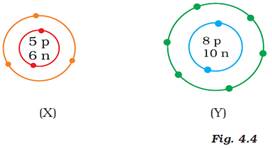
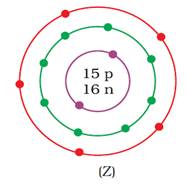
What information do you get from the Fig. 4.4 about the atomic number, mass number and valency of atoms X, Y and Z? Give your answer in a tabular form.

28

In response to a question, a student stated that in an atom, the number of protons is greater than the number of neutrons, which in turn is greater than the number of electrons. Do you agree with the statement? Justify your answer.

30

Match the names of the Scientists given in column A with their contributions towards the understanding of the atomic structure as given in column B


(A)


(B)


(a) Ernest Rutherford


(i) Indivisibility of atoms


(b) J.J.Thomson


(ii) Stationary orbits


(c) Dalton


(iii) Concept of nucleus


(d) Neils Bohr


(iv) Discovery of electrons


(e) James Chadwick


(v) Atomic number


(f) E. Goldstein


(vi) Neutron


(g) Mosley


(vii) Canal rays


31

The atomic number of calcium and argon are 20 and 18 respectively, but the mass number of both these elements is 40. What is the name given to such a pair of elements?

Questions · 43
4. Structure of The Atom
1 2 3 4 5 6 7 8 9 10 11 12 13 14 15 16 17 18 19 20 21 22 23 24 25 26 27 28 29 30 31 32 33 34 35 36 37 38 39 40 41 42 43
Back to chapter
ADVERTISEMENT
About Contact Privacy Terms
Philoid · 2026
  • Home
  • Search
  • Browse
  • Quiz
  • Saved