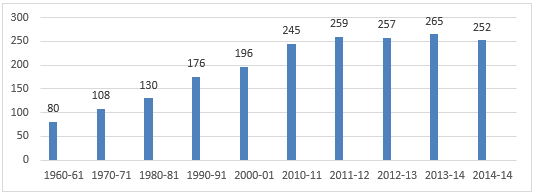
Study the Graph given below and answer the following questions:
Central Food grains (Wheat + Rice) Stock and Minimum Buffer Norm (Million Tonnes)

Study the graph above and answer the following questions:
1. In which recent year food grains stock with the government was maximum?
2. What is the minimum buffer stock norm for the FCI?
3. Why were the FCI granaries overflowing with food grains?
1. 2012-13 saw the maximum collection of grains with the government. This was because of the high production and better buying strategies of the government. This led to more of the grain being deposited with the government as the farmers were getting good price for their yield.
2. The minimum buffer stock norms for FCI (Food corporation of India) are 24.3 million tonnes upto July. Buffer stock is the stock of food grains, namely wheat and rice procured by the government through Food Corporation of India(FCI). It purchases wheat and rice from the farmers in states where there is surplus production, and for this they are paid a pre-determined price which is called minimum support price.
3. The Minimum support price is declared by the government every year before the sowing season to provide incentives to the farmers for raising production of the crops. As the market prices for the buying from the farmers is usually lower than MSP and the chances of cheating or malpractices are high, thus the farmers usually prefer to sell the grain to the government. This grain has to be used for supplying to the PDS system and during calamities. The distribution network is not as competent as it should be and thus there is excess grains in the granaries.
Couldn't generate an explanation.
Generated by AI. May contain inaccuracies — always verify with your textbook.