Q3 of 24 Page 119

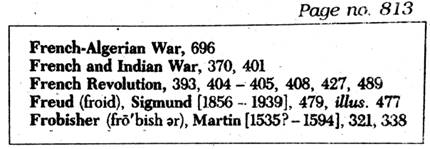
Given below is a portion of an index page from the book, French’s Index of Differential Diagnosis, edited by F. Dudley Hart M.D., F.R.C.P.


Study the entries and find out whether the following topics are discussed in the book.


(i) bronchitis due to cigarette smoking


(ii) heart failure due to bronchitis


(iii) bronchitis in children

The given three topics – bronchitis due to cigarette smoking, heart failure due to bronchitis and bronchitis in children can be easily found in the given book as per the entries mentioned in the same words.


More from this chapter

All 24 →
3

An index is a list of names or topics that are to be found in a book. It is a list arranged in alphabetical order at the end of a book.

The following paragraph shows that the doctor is consulting the index of a medical book to find out which injection is appropriate for Bruno.


“Out came his medical books, and a feverish reference to index began: What poison did you say, sir?” “Barium carbonate”. “Ah yes—B—Ba— Barium Salts—Ah! Barium carbonate! Symptoms—paralysis— treatment—injections of ... Just a minute, sir. I’ll bring my syringe and the medicine.”


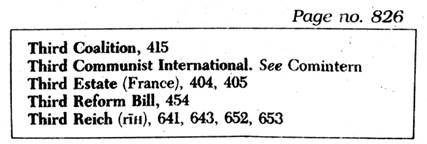
You have read about the French Revolution and you want to know more about the Third Estate in the context of the French Revolution. You can refer to the index of the book Living World History by T. Walter Wallbank and Arnold Schrier:


On which pages in this book will you find information about the French Revolution and the Third Estate?

3

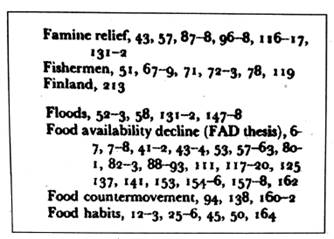
To know what ‘Food Security’ and ‘Minimum Support Price’ mean in the context of the economic growth of a country you can go to the subject index given below from Poverty and Famines — An Essay on Entitlement and Deprivation by Amartya Sen. Under which heading in the index are you likely to find these topics?

4

Notice the incomplete sentences in the following paragraphs. Here the writer is using incomplete sentences in the narration to make the incident more dramatic or immediate. Can you rewrite the paragraph in complete sentences?

(You can begin: The vet and I made a dash back to the car. Bruno was still floundering ...)


(i) A dash back to the car. Bruno still floundering about on his stumps, but clearly weakening rapidly; some vomiting, heavy breathing, with heaving flanks and gaping mouth.


Hold him, everybody! In goes the hypodermic—Bruno squeals — 10 c.c. of the antidote enters his system without a drop being wasted. Ten minutes later: condition unchanged! Another 10 c.c. injected! Ten minutes later: breathing less stertorous — Bruno can move his arms and legs a little although he cannot stand yet. Thirty minutes later: Bruno gets up and has a great feed! He looks at us disdainfully, as much as to say, ‘What’s barium carbonate to a big black bear like me?’ Bruno is still eating.


(ii) In the paragraphs above from the story the verbs are in the present tense (eg. hold, goes, etc.). This gives the reader an impression of immediacy. The present tense is often used when we give a commentary on a game (cricket, football, etc.), or tell a story as if it is happening now. It is, therefore, called the narrative present.


You will read more about the present tense in Unit 10.

4

Find the adverbs in the passage below. (You’ve read about adverbs in Unit 1.)

(i) Complete the following sentences, using a suitable adverb ending in –ly.


(a) Rana does her homework____________.


(b) It rains______________ in Mumbai in June.


(c) He does his work ____________.


(d) The dog serves his master_____________.


(ii) Choose the most suitable adverbs or adverbial phrases and complete the following sentences.


(a) We should ____________________ get down from a moving train. (never, sometimes, often)


(b) I was _______________ in need of support after my poor performance. (badly, occasionally, sometimes)


(c) Rita met with an accident. The doctor examined her_________________. (suddenly, seriously, immediately)