Q20 of 38 Page 88

Two charged conducting spheres of radii a and b are connected to each other by a wire. What is the ratio of electric fields at the surfaces of the two spheres? Use the result obtained to explain why charge density on the sharp and pointed ends of a conductor is higher than on its flatter portions.

Let a be the radius of the sphere A, QA be the charge on the sphere, and CA be the capacitance of the sphere. Let b be the radius of the sphere B, QB be the charge on the sphere, and CB be the capacitance of the sphere. Since, the two spheres are connected with wire, their potential V is equal.


Electric field generated by a charge, E =


Where,


q = charge


d = distance from origin


ϵ0 = permittivity of space


Let EA be the electric field for sphere A and EB be the electric field for sphere B. Therefore their ratio,


=


However, = and =


=


= =


Hence, the ration of electric fields at surface is


More from this chapter

All 38 →
18

In a hydrogen atom, the electron and proton are bound at a distance of about 0.53 Å:

(a) Estimate the potential energy of the system in eV, taking the zero of the potential energy at infinite separation of the electron from proton.


(b) What is the minimum work required to free the electron, given that its kinetic energy in the orbit is half the magnitude of potential energy obtained in (a)?


(c) What are the answers to (a) and (b) above if the zero of potential energy is taken at 1.06 Å separation?

19

If one of the two electrons of a H2 molecule is removed, we get a hydrogen molecular ion H+2. In the ground state of an H+2, the two protons are separated by roughly 1.5 Å, and the electron is roughly 1 Å from each proton. Determine the potential energy of the system. Specify your choice of the zero of potential energy.

21

Two charges –q and + q are located at points (0, 0, –a) and (0, 0, a), respectively.

(a) What is the electrostatic potential at the points (0, 0, z) and (x, y, 0)?


(b) Obtain the dependence of potential on the distance r of a point from the origin when r/a >> 1.


(c) How much work is done in moving a small test charge from the point (5,0,0) to (–7,0,0) along the x-axis? Does the answer change if the path of the test charge between the same points is not along the x-axis?

22

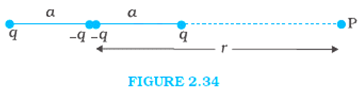
Figure 2.34 shows a charge array known as an electric quadrupole. For a point on the axis of the quadrupole, obtain the dependence of potential on r for r/a >> 1, and contrast your results with that due to an electric dipole, and an electric monopole (i.e., a single charge).