Q12 of 18 Page 231

A square loop of side 12 cm with its sides parallel to X and Y axes is moved with a velocity of 8 cm s–1 in the positive x - direction in an environment containing a magnetic field in the positive z - direction. The field is neither uniform in space nor constant in time. It has a gradient of 10–3 T cm–1 along the negative x - direction (that is it increases by 10–3 T cm–1 as one moves in the negative x - direction), and it is decreasing in time at the rate of 10–3 T s–1. Determine the direction and magnitude of the induced current in the loop if its resistance is 4.50 mW.

Given: side of square loop = 12 cm

In metre, the side of square loop = 0.12m


Area of the square loop = 0.12 × 0.12 = 144 × 10 - 4m2


Velocity of the loop = 8 cms-1


In metre/s, the velocity of the loop, v= 0.08m/s


Since gradient of electric field is along negative x - direction


In Tm - 1,


The rate of decrease of magnetic field in time is given as:


Resistance of the square loop = 4.50 mΩ =4.5 × 10 - 3


Due to change in the motion of the square loop in presence of non - uniform magnetic field, the decrease in the magnetic flux is given as:


Due to explicit time variation in magnetic field, the rate of change of flux is given by:


Substituting values in above, we get


The total emf induced in the square loop is :


e =1.44 × 10⁻⁵ V+ 11.52× 10⁻⁵ V


e = 12.96 × 10⁻⁵ V


The induced current can be written as:


i =e/R


i = 2.88 × 10 - 2A


The current direction will be in the way that there will be increase in the flux along positive z direction.


More from this chapter

All 18 →
10

A jet plane is travelling towards west at a speed of 1800 km/h. What is the voltage difference developed between the ends of the having a span of 25 m, if the Earth’s magnetic field at the location has a magnitude of 5 × 10⁻⁴ T and the dip angle is 30°.

11

Suppose the loop in Exercise 6.4 is stationary but the current feeding the electromagnet that produces the magnetic field is gradually reduced so that the field decreases from its initial value of 0.3 T at the rate of 0.02 T s–1. If the cut is joined and the loop has a resistance of 1.6Ω , how much power is dissipated by the loop as heat? What is the source of this power?

13

It is desired to measure the magnitude of field between the poles of a powerful loud speaker magnet. A small flat search coil of area 2 cm2 with 25 closely wound turns, is positioned normal to the field direction, and then quickly snatched out of the field region.

Equivalently, one can give it a quick 90° turn to bring its plane parallel to the field direction). The total charge flown in the coil (measured by a ballistic galvanometer connected to coil) is 7.5 mC. The combined resistance of the coil and the galvanometer is 0.50. Estimate the field strength of magnet.

14

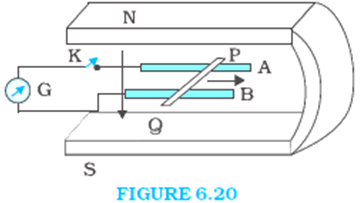
Figure 6.20 shows a metal rod PQ resting on the smooth rails AB and positioned between the poles of a permanent magnet. The rails, the rod, and the magnetic field are in three mutual perpendicular directions. A galvanometer G connects the rails through a switch K. Length of the rod = 15 cm, B = 0.50 T, resistance of the closed loop containing the rod = 9.0 mW. Assume the field to be uniform.


(a) Suppose K is open and the rod is moved with a speed of 12 cm s–1 in the direction shown. Give the polarity and magnitude of the induced emf.


(b) Is there an excess charge built up at the ends of the rods when K is open? What if K is closed?


(c) With K open and the rod moving uniformly, there is no net force on the electrons in the rod PQ even though they do experience magnetic force due to the motion of the rod. Explain.


(d) What is the retarding force on the rod when K is closed?


(e) How much power is required (by an external agent) to keep the rod moving at the same speed (=12cm s–1) when K is closed? How much power is required when K is open?


(f) How much power is dissipated as heat in the closed circuit? What is the source of this power?


(g) What is the induced emf in the moving rod if the magnetic field is parallel to the rails instead of being perpendicular?