Given a + b + c + d = 0, which of the following statements are correct:
A. a, b, c, and d must each be a null vector,
B. The magnitude of (a + c) equals the magnitude of (b + d),
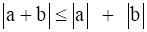
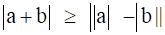
C. The magnitude of a can never be greater than the sum of the magnitudes of b, c, and d,
D. b + c must lie in the plane of a and d if a and d are not collinear, and in the line of a and d, if they are collinear?
A. Incorrect
Explanation: It is not necessary that the vectors  ,
, ,
, and
and  be null vectors for their sum to be a null vector. There can be other combinations as well. For example, if
  then
then
 .
.
B. Correct
Explanation:

⇒ 
Taking modulus on both sides,

⇒ 
Hence, magnitude of ( ) is equal to the magnitude of (
 ).
).
C. Correct
Explanation:

⇒ 
Taking modulus on both sides,

⇒ 
Hence, the magnitude of is always equal to the magnitude of
  and can never be greater than that.
D. Correct
Explanation: For the sum  to be a null vector, the vectors
  ,
, and
and  must be three sides of a triangle according to triangle law of vector addition. The three sides of a triangle lie on the same plane. Hence, the vectors
  ,
, and
and  must be coplanar. But if
  and
and  are collinear, then
 must lie on the same line and in opposite direction in order to cancel out
  in the sum
  .
.
NOTE: Triangle law of vector addition states that when two vectors are represented by two sides of a triangle in magnitude and direction taken in same order then third side of the third side of that triangle represents in magnitude and direction the resultant of the vectors.
Couldn't generate an explanation.
Generated by AI. May contain inaccuracies — always verify with your textbook.