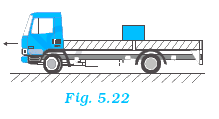
The rear side of a truck is open and a box of 40 kg mass is placed 5 m away from the open end as shown in Fig. 5.22. The coefficient of friction between the box and the surface below it is 0.15. On a straight road, the truck starts from rest and accelerates with 2 m s-2. At what distance from the starting point does the box fall off the truck? (Ignore the size of the box).

Given:
Mass of the block, M = 40 Kg
Co-efficient of friction, � = 0.15
Initial velocity, u = 0ms-1
Acceleration, a = 2ms-2
Distance of Box from the end of truck, s = 5m
Using the Newton’s 3rd law of motion, the force on the Box, F can be written as,
F = M× a
F = 40Kg × 2 ms-2
F = 80 N
Since there is friction between the truck and the body, we can write frictional force as,
fs = �× M× g
fs = 0.15× 40Kg × 10ms-2
fs = 60 N.
Since, force of friction is less than that of exerted by the truck, there exists a net force on Box.
FNet = F-fs
FNet = 80 N – 60 N
FNet = 20 N
This force acts in backward direction.
We can find the acceleration of the Box using Newton’s second Law,
FNet = M× a
a = 20 N/ 40 Kg
a = 0.5 ms-2
The box accelerates in backward direction at the rate of 0.5 ms -2.
Since, box is 5 m away from end, i.e. 5 m away from falling down, so we can use the second equation of motion to find the time of fall.
Second equation of motion is given as,
s = ut + 1/2 at2 …1
Where,
s = distance travelled
u = initial velocity
t = time
a = acceleration
Since box was at rest initially so u = 0ms-1
Equation 1 can be re-written as,
S = 1/2 at2
→ t = (2s/a)1/2
→ t = 201/2 s
Now, the distance travelled by truck till the time of fall can also be calculated by equation 1
s = ut + 1/2 at2
s = 0 + 0.5 × 2× (201/2)2
s = 20 m
Couldn't generate an explanation.
Generated by AI. May contain inaccuracies — always verify with your textbook.