Q4 of 30 Page 134

The potential energy function for a particle executing linear simple harmonic motion is given by V(x) = kx2/2, where k is the force constant of the oscillator. For k = 0.5 N m-1, the graph of V(x) versus x is shown in Fig. 6.12. Show that a particle of total energy 1 J moving under this potential must ‘turn back’ when it reaches x = � 2 m.

Given,

Total energy of the particle, E = 1 J


Force constant, k = 0.5 N m-1


The total energy is equal to the sum of kinetic energy and potential energy.


So, E = PE + K


E = kx2 + mv2


So, 1 = kx2 + mv2


When the velocity of the particle is zero i.e., at the turning point, the kinetic energy is zero.


1 = kx2


x2 = 2/k


x2 = 2/0.5


x2 = 4


x = �2


Hence, the particle turns back at x= �2.


More from this chapter

All 30 →
2

A body of mass 2 kg initially at rest moves under the action of an applied horizontal force of 7 N on a table with coefficient of kinetic friction = 0.1. Compute the

A. work done by the applied force in 10 s,


B. work done by friction in 10 s,


C. work done by the net force on the body in 10 s,


D. change in kinetic energy of the body in 10 s, and interpret your results.

3

Given in Fig. 6.11 are examples of some potential energy functions in one dimension. The total energy of the particle is indicated by a cross on the ordinate axis. In each case, specify the regions, if any, in which the particle cannot be found for the given energy. Also, indicate the minimum total energy the particle must have in each case. Think of simple physical contexts for which these potential energy shapes are relevant.

5

Answer the following:

A. The casing of a rocket in flight burns up due to friction. At whose expense is the heat energy required for burning obtained? The rocket or the atmosphere?


B. Comets move around the sun in highly elliptical orbits. The gravitational force on the comet due to the sun is not normal to the comet’s velocity in general. Yet the work done by the gravitational force over every complete orbit of the comet is zero. Why?


C. An artificial satellite orbiting the earth in very thin atmosphere loses its energy gradually due to dissipation against atmospheric resistance, however small. Why then does its speed increase progressively as it comes closer and closer to the earth?


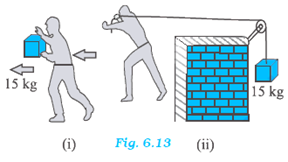
D. In Fig. 6.13(i) the man walks 2 m carrying a mass of 15 kg on his hands. In Fig. 6.13(ii), he walks the same distance pulling the rope behind him. The rope goes over a pulley, and a mass of 15 kg hangs at its other end. In which case is the work done greater?


6

Underline the correct alternative:

A. When a conservative force does positive work on a body, the potential energy of the body increases/decreases/remains unaltered.


B. Work done by a body against friction always results in a loss of its kinetic/potential energy.


C. The rate of change of total momentum of a many-particle system is proportional to the external force/sum of the internal forces on the system.


D. In an inelastic collision of two bodies, the quantities which do not change after the collision are the total kinetic energy/total linear momentum/total energy of the system of two bodies.