Q24 of 33 Page 178

A bullet of mass 10 g and speed 500 m/s is fired into a door and gets embedded exactly at the centre of the door. The door is 1.0 m wide and weighs 12 kg. It is hinged at one end and rotates about a vertical axis practically without friction. Find the angular speed of the door just after the bullet embeds into it.

Given:

Mass of Bullet, m = 10g = 10-3 kg


Speed of bullet, v = 500m/s


Width of the door, w = 1m


Distance from hinge where bullet hits, r = 0.5 m


Mass of door, M = 12 Kg


We know that angular moment is given by,


α = mvr


where,


α = angular momentum


m = mass of the body


v = velocity of the body


r = radius of the body


by putting the value, we get,


α = 10 × 10-3 kg × 500 ms-1 × 0.5 m


α = 2.5 Kgm2s-1 …(i)


Moment of inertia is given by,


I = ML2/3 (For rectangle)


Where,


M = mass of door


L = width of door


I = 1/3 × 12 Kg × (1m)2


I = 4 Kgm2


We also have,


α = Iω


where is α is the angular momentum


l is the linear momentum


ω is the angular velocity


ω = α /I


By putting the values, we get,


ω = 2.5/ 4


ω = 0.625 rad s-1


Note: It is a good practice to memorise the moment of inertia for common shapes like rectangle, circle, triangle, cylinder and sphere.


More from this chapter

All 33 →
22

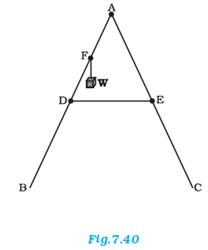
As shown in Fig.7.40, the two sides of a step ladder BA and CA are 1.6 m long and hinged at A. A rope DE, 0.5 m is tied half way up. A weight 40 kg is suspended from a point F, 1.2 m from B along the ladder BA. Assuming the floor to be frictionless and neglecting the weight of the ladder, find the tension in the rope and forces exerted by the floor on the ladder. (Take g = 9.8 m/s2)

(Hint: Consider the equilibrium of each side of the ladder separately.)


23

A man stands on a rotating platform, with his arms stretched horizontally holding a 5 kg weight in each hand. The angular speed of the platform is 30 revolutions per minute. The man then brings his arms close to his body with the distance of each weight from the axis changing from 90cm to 20cm. The moment of inertia of the man together with the platform may be taken to be constant and equal to 7.6 kg m2.

A. What is his new angular speed? (Neglect friction.)


B. Is kinetic energy conserved in the process? If not, from where does the change come about?

25

Two discs of moments of inertia I1 and I2 about their respective axes (normal to the disc and passing through the centre), and rotating with angular speeds w1 and w2 are brought into contact face to face with their axes of rotation coincident. (a) What is the angular speed of the two-disc system? (b) Show that the kinetic energy of the combined system is less than the sum of the initial kinetic energies of the two discs. How do your account for this loss in energy? Take .

26

A. Prove the theorem of perpendicular axes.

(Hint: Square of the distance of a point (x, y) in the x–y plane from an axis through the origin and perpendicular to the plane is x2 + y2).


B. Prove the theorem of parallel axes.


(Hint: If the centre of mass is chosen to be the origin ).