Q12 of 31 Page 358

Plot the corresponding reference circle for each of the following simple harmonic motions. Indicate the initial (t =0) position of the particle, the radius of the circle, and the angular speed of the rotating particle. For simplicity, the sense of rotation may be fixed to be anticlockwise in every case: (x is in cm and t is in s).

x = –2 sin (3t + π/3)

We know here we are given equation of simple harmonic motion as


x = –2 sin (3t + π/3)


Converting to Cosine


Using Cos(π/2+

More from this chapter

All 31 →
10

In Exercise 14.9, let us take the position of mass when the spring is unstreched as x = 0, and the direction from left to right as the positive direction of x-axis. Give x as a function of time t for the oscillating mass if at the moment we start the stopwatch (t = 0), the mass is

(a) at the mean position,


(b) at the maximum stretched position, and


(c) at the maximum compressed position.


In what way do these functions for SHM differ from each other, in frequency, in amplitude or the initial phase?

11

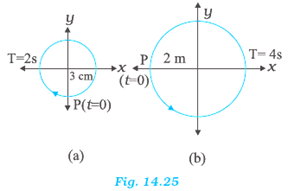
Figures 14.25 correspond to two circular motions. The radius of the circle, the period of revolution, the initial position, and the sense of revolution (i.e. clockwise or anti-clockwise) are indicated on each figure.


Obtain the corresponding simple harmonic motions of the x-projection of the radius vector of the revolving particle P, in each case.

12

Plot the corresponding reference circle for each of the following simple harmonic motions. Indicate the initial (t =0) position of the particle, the radius of the circle, and the angular speed of the rotating particle. For simplicity, the sense of rotation may be fixed to be anticlockwise in every case: (x is in cm and t is in s).

x = cos (π/6 – t)

12

Plot the corresponding reference circle for each of the following simple harmonic motions. Indicate the initial (t =0) position of the particle, the radius of the circle, and the angular speed of the rotating particle. For simplicity, the sense of rotation may be fixed to be anticlockwise in every case: (x is in cm and t is in s).

x = 3 sin (2πt + π/4)