Skip to content
Philoid
Browse Saved
Back to chapter
Mathematics
9. Areas of Parallelograms and Triangles
Home · Class 9 · Mathematics · NCERT - Mathematics · 9. Areas of Parallelograms and Triangles
Prev
Next
Q11 of 31 Page 162

In Fig. 9.27, ABCDE is a pentagon. A line through B parallel to AC meets DC produced at F. Show that:

(i) ar (ACB) = ar (ACF)


(ii) ar (AEDF) = ar (ABCDE)


(i) ΔACB and ΔACF lie on the same base AC and are between the same parallels AC and BF

Area (ΔACB) = Area (ΔACF)


(ii) It can be observed that:


Area (ΔACB) = Area (ΔACF)


Area (ΔACB) + Area (ACDE) = Area (ACF) + Area (ACDE)


Area (ABCDE) = Area (AEDF)


More from this chapter

All 31 →
9

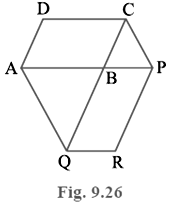
The side AB of a parallelogram ABCD is produced to any point P. A line through A and parallel to CP meets CB produced at Q and then parallelogram PBQR is completed (see Fig. 9.26). Show that ar (ABCD) = ar (PBQR).


[Hint: Join AC and PQ. Now compare ar (ACQ) and ar (APQ)]

10

Diagonals AC and BD of a trapezium ABCD with AB || DC intersect each other at O. Prove that ar (AOD) = ar (BOC)

12

A villager Itwaari has a plot of land of the shape of a quadrilateral. The Gram Panchayat of the village decided to take over some portion of his plot from one of the corners to construct a Health Centre. Itwaari agrees to the above proposal with the condition that he should be given equal amount of land in lieu of his land adjoining his plot soas to form a triangular plot. Explain how this proposal will be implemented.

13

ABCD is a trapezium with AB || DC. A line parallel to AC intersects AB at X and BC at Y. Prove that ar (ADX) = ar (ACY)

[Hint: Join CX]

Questions · 31
9. Areas of Parallelograms and Triangles
1 1 2 3 4 5 6 1 2 3 4 5 6 7 8 9 10 11 12 13 14 15 16 1 2 3 4 5 6 7 8
Back to chapter
ADVERTISEMENT
About Contact Privacy Terms
Philoid · 2026
  • Home
  • Search
  • Browse
  • Quiz
  • Saved