Skip to content
Philoid
Browse Saved
Back to chapter
Maths
13. Surface Areas and Volumes
Home · Class 10 · Maths · NCERT - Mathematics · 13. Surface Areas and Volumes
Prev
Next
Q1 of 38 Page 257

A drinking glass is in the shape of a frustum of acone of height 14 cm. The diameters of its two circular ends are 4 cm and 2 cm. Find the capacity of the glass

Given:

Radius (r1) [Upper base] =


= 2 cm


Radius (r2) [Lower base] = = 1 cm


Capacity of glass = Volume of frustum of cone


= h (r12 + r22 + r1r2)


= h [(2)2 + (1)2 + (2) (1)]


= * * 14 [4 + 1 + 2]


=


= 102 cm3


Hence, the capacity of the glass = 102 cm3


More from this chapter

All 38 →
8

Water in a canal, 6 m wide and 1.5 m deep, is flowing with a speed of 10 km/h. How much area will it irrigate in 30 minutes, if 8 cm of standing water is needed?

9

A farmer connects a pipe of internal diameter 20 cm from a canal into a cylindrical tank in her field, which is 10 m in diameter and 2 m deep. If water flows through the pipe at the rate of 3 km/h, in how much time will the tank be filled?

2

The slant height of a frustum of a cone is 4 cm and the perimeters (circumference) of its circular endsare 18 cm and 6 cm. Find the curved surface area of the frustum

3

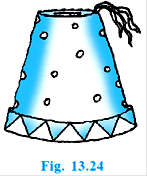
A fez, the cap used by the Turks, is shaped like the frustum of a cone (see Fig. 13.24). If its radius on the open side is 10 cm, radius at the upper base is 4 cm and its slant height is 15 cm, find the area of material used for making it

Questions · 38
13. Surface Areas and Volumes
1 2 3 4 5 6 7 8 9 1 2 3 4 5 6 7 8 1 2 3 4 5 6 7 8 9 1 2 3 4 5 1 2 3 4 5 6 7
Back to chapter
ADVERTISEMENT
About Contact Privacy Terms
Philoid · 2026
  • Home
  • Search
  • Browse
  • Quiz
  • Saved