Q38 of 55 Page 72

The following graph gives the information about the number of railway tickets sold for different cities on a railway ticket counter between 6.00 am to 10.00 am. Read the bar graph and answer the following questions.

Scale : 1 unit length = 10 tickets


A. How many tickets were sold in all?


B. For which city were the maximum number of tickets sold?


C. For which city were the minimum number of tickets sold?


D. Name the cities for which the number of tickets sold is more than 20.


E. Fill in the blanks:


Number of tickets sold for Delhi and Jaipur together exceeds the total number of tickets sold for Patna and Chennai by _______.

(A) 290


Total number of tickets sold = sum of number of tickets sold for Patna , Jaipur, Delhi, Chennai and Guwahati.


Total number of tickets sold = 80+50+100+20+40 = 290


(B) Delhi


From the above graph, it can be observed that the number of tickets sold for Delhi was 100 which is the most number among the other cities.


(C) Chennai


From the above graph, it can be observed that the number of tickets sold for Chennai was 20 which is the least number among the other cities.


(D) Patna, Jaipur, Delhi and Guwahati


From the graph, it can be observed that the only city with total number of tickets sold 20 is Chandigarh. The rest of the cities have more number of tickets sold.


(E) 50


Total number of tickets sold for Delhi and Jaipur together = 150


Total number of tickets sold for Patna and Chennai together = 100


Difference = 150 – 100 = 50


More from this chapter

All 55 →
36

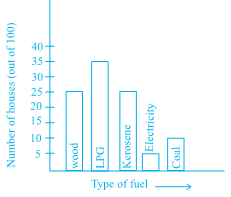
The following bar graph shows the number of houses (out of 100) in a town using different types of fuels for cooking.

Read the bar graph and answer the following questions:


Scale: 1 unit length = 5 houses


A. Which fuel is used in maximum number of houses?


B. How many houses are using coal as fuel?


C. Suppose that the total number of houses in the town is 1 lakh.


From the above graph estimate the number of houses using electricity.

37

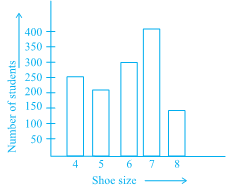
The following bar graph represents the data for different sizes of shoes worn by the students in a school. Read the graph and answer the following questions.

Scale: 1 unit length = 50 students


A. Find the number of students whose shoe sizes have been collected.


B. What is the number of students wearing shoe size 6?


C. What are the different sizes of the shoes worn by the students?


D. Which shoe size is worn by the maximum number of students?


E. Which shoe size is worn by minimum number of students?


F. State whether true or false:


The total number of students wearing shoe sizes 5 and 8 is the same as the number of students wearing shoe size 6.

39

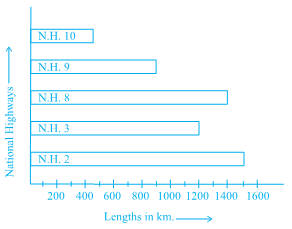
The bar graph given below represents approximate length (in kilometres) of some National Highways in India. Study the bar

graph and answer the following questions:


Scale: 1 unit length = 200km


A. Which National Highway (N.H.) is the longest among the above?


B. Which National Highway is the shortest among the above?


C. What is the length of National Highway 9?


D. Length of which National Highway is about three times the National Highway10?

40

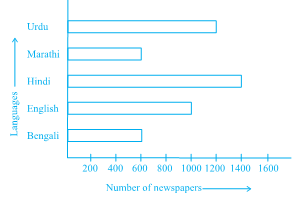
The bar graph given below represents the circulation of newspapers in different languages in a town. Study the bar graph and answer the following questions:

Scale: 1 unit length = 200 Newspapers


A. What is the circulation of English newspaper?


B. Name the two languages in which circulation of newspaper is the same.


C. By how much is the circulation of newspaper in Hindi more than the newspaper in Bengali?