Q5 of 13 Page 236

Use the tables below to draw linear graphs.

A. The number of days a hill side city received snow in different years.


Year


2003


2004


2005


2006


Days


8


10


5


12


B. Population (in thousands) of men and women in a village in different years.


Year


2003


2004


2005


2006


2007


Number of Men


12


12.5


13


13.2


13.5


Number of Women


11.3


11.9


13


13.6


12.8


A. By taking the years on x-axisand the number of days on y-axis, the linear graph of the given information can be represented as:


B. By taking the years on x-axis and population on y-axis, the given information can be represented through linear graph as:


More from this chapter

All 13 →
3

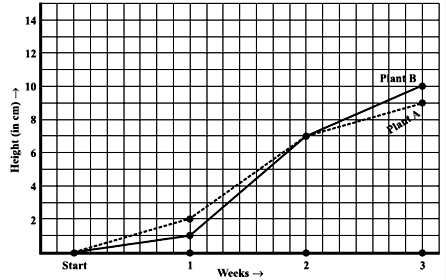
For an experiment in Botany, two different plants, plant A and plant B were grownunder similar laboratory conditions. Their heights were measured at the end of eachweek for 3 weeks. The results are shown by the following graph.


A. How high was Plant A after (i) 2 weeks (ii) 3 weeks?


B. How high was Plant B after (i) 2 weeks (ii) 3 weeks?


C. How much did Plant A grow during the 3rd week?


D. How much did Plant B grow from the end of the 2nd week to the end of the3rd week?


E. During which week did Plant A grow most?


F. During which week did Plant B grow least?


G. Were the two plants of the same height during any week shown here? Specify.

4

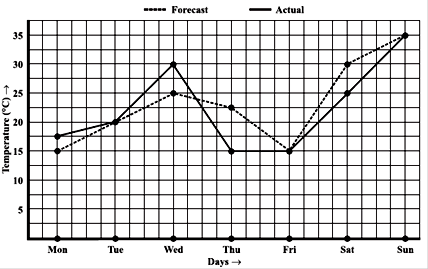
The following graph shows the temperature forecast and the actual temperature foreach day of a week.

A. On which days was the forecast temperature the same as the actual temperature?


B. What was the maximum forecast temperature during the week?


C. What was the minimum actual temperature during the week?


D. On which day did the actual temperature differ the most from the forecasttemperature?


6

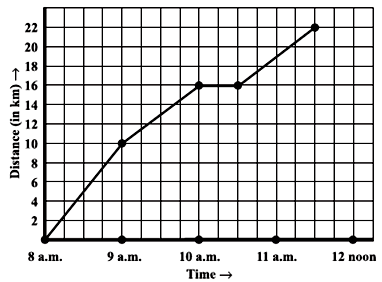
A courier-person cycles from a town to a neighbouring suburban area to deliver aparcel to a merchant. His distance from the town at different times is shown by thefollowing graph.

A. What is the scale taken for the time axis?


B. How much time did the person take for the travel?


C. How far is the place of the merchant from the town?


D. Did the person stop on his way? Explain.


E. During which period did he ride fastest?


7

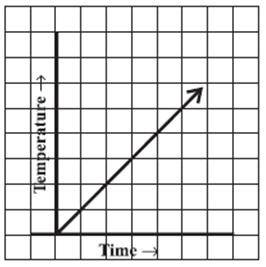
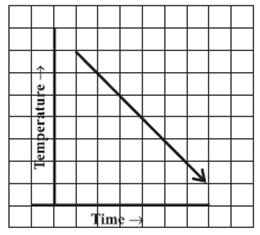
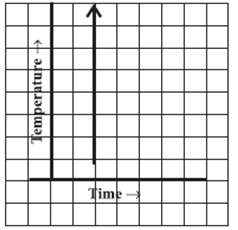
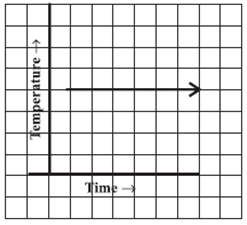
Can there be a time-temperature graph as follows? Justify your answer.

(i)


(ii)


(iii)


(iv)