Q25 of 70 Page 11

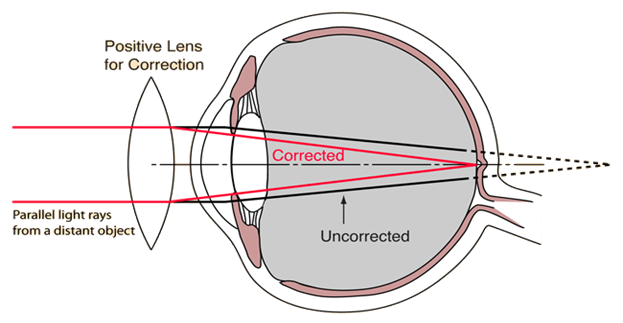
Study the given diagram and answer the questions that follows:


i. Which defect of vision is represented in this case? Give a reason for your answer.


ii. What could be the two causes of this defect?


iii. With the help of a diagram showing how this defect can be corrected by the use of the suitable lens.

i. The figure represents Hypermetropia. Hypermetropia or far sightedness is an eye defect in which a person is not able to see things placed closer to the eye. The light rays coming from the object placed between near point & the point of least distance of distinct vision, after refraction from the eye lens converges to a point beyond the retina. This implies that the image is formed beyond the eye thus creating a blurry image. In such cases the focal length of the eye lens increases.

ii. Some of the causes of hypermetropia are:


Low converging power of eye lens because of weak action of ciliary muscles.


Abnormal shape of the cornea


iii. The defect can be corrected by using the convex lens. To bring the image on retina a double convex lens is used. The double convex lens converges the light rays coming from the object in front of the eye lens. In other words, the convex lens creates an image of the object at the near point. Now this image acts as an object for the eye lens and thus forming an image on the retina.

More from this chapter

All 70 →
23

a.Write the functions of each of the following parts of the human eye:

i. Cornea


ii. Iris


iii. Crystalline (Eye) lens


iv. Ciliary muscles


v. Retina

b. 
A person is unable to see distinctly the objects closer than 1 m. Name the defect of vision he is suffering from. Draw ray diagrams to illustrate the cause of the defect and its correction by suitable lens.

24

Give reasons for each of the following:

i. The sky appears dark instead of blue to an astronaut in space.


ii. The sky near the horizon appears to have a reddish hue at the time of sunset and sunrise.


iii. The stars appear to twinkle.

26

A person is unable to see distinctly the words printed on a newspaper. Name the defect of vision he is suffering from. Draw ray diagram to illustrate this defect. List its two possible causes. Draw a ray diagram to show how this defect may be corrected using a lens of appropriate focal length.

27

A student finds the writing on the blackboard as blurred and unclear when sitting on the last desk of the classroom. He, however, sees clearly when sitting on the front desk at an approximate distance 2 m from the blackboard.

(i) Draw the ray diagram to illustrate the formation of image of the blackboard writing by his eye lens when he sits at the (a) last desk, (b) front desk


(ii) Name the defect of vision the student is suffering from. Also, list two causes of this defect.


(iii)Name the kind of lens would enable him to see clearly when he is seated at the last desk. Draw the ray diagram to illustrate how this helps him to see clearly.