Skip to content
Philoid
Browse Saved
Back to chapter
Maths
6. Triangles
Home · Class 10 · Maths · Ref. Book · 6. Triangles
Prev
Next
Q25 of 32 Page 6

In ΔABC, D is the midpoint of BC and AE ⊥ BC. If AC > AB, show that

AB2 = AD2 — BC • DE + 1/4 BC2 (CBSE 2006)

In right-angled triangle AED, applying Pythagoras theorem,
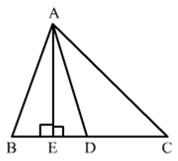


AB2 = AE2 + BE2


⇒ AE2 = AB2 – BE2 ….(i)


In right-angled triangle AED, applying Pythagoras theorem,


AD2 = AE2 + ED2


⇒ AE2 = AD2 – ED2 ….(ii)


Therefore,


AB2 – BE2 = AD2 – ED2



More from this chapter

All 32 →
23

ABC is an isosceles triangle, right-angled at B. Similar triangles ACD and ABE are constructed on sides AC and AB. Find the ratio between the areas of ΔABE and ΔACD.

(CBSE 2002)

24

Two poles of heights 6 m and 11 m stand on aplane ground. If the distance between the feetof the poles is 12 m, find the distance between their tops. (CBSE 2002)

25

In the given figure, O is a point inside a ΔPQR such that ∠POR = 90°, OP = 6 cm and OR = 8 cm. If PQ = 24 cm and QR = 26 cm, prove that ΔPQR is right-angled.

(CBSE 2006, 2009)

27

In an equilateral triangle, prove that three times the square of one side is equal to four times the square of one of its altitudes. (CBSE 2002, 2007)

Questions · 32
6. Triangles
1 2 3 4 5 6 7 8 9 10 11 12 13 14 15 16 17 18 19 20 21 22 23 24 25 25 27 28 29 30 31 32
Back to chapter
ADVERTISEMENT
About Contact Privacy Terms
Philoid · 2026
  • Home
  • Search
  • Browse
  • Quiz
  • Saved

