Solution of Chapter 9. Circles (NCERT - Exemplar Mathematics Book)
Chapter Exercises
Exercise 9.1
If radii of two concentric circles are 4 cm and 5 cm, then length of each chord of one circle which is tangent to the other circle, is
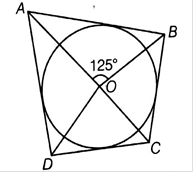
view answer >In figure, if ∠AOB = 125°, then ∠COD is equal to
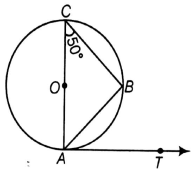
In figure, AB is a chord of the circle and AOC is its diameter such that ∠ACB = 50°. If AT is the tangent to the circle at the point A, then ∠BAT is equal to
From a point P which is at a distance of 13 cm from the center 0 of a circle of radius 5 cm, the pair of tangents PQ and PR to the circle is drawn. Then, the area of the quadrilateral PQOR is
view answer >At one end A of a diameter AB of a circle of radius 5 cm, tangent XAY is drawn to the circle. The length of the chord CD parallel to XY and at a distance 8 cm from A, is
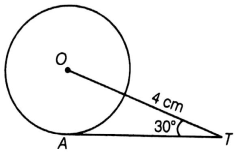
view answer >In figure, AT is a tangent to the circle with center 0 such that OT = 4 cm and ∠OTA = 30°. Then, AT is equal to
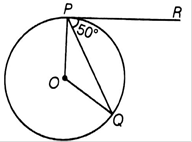
In figure, if 0 is the center of a circle, PQ is a chord and the tangent PR at P makes an angle of 50° with PQ, then ∠POQ is equal to
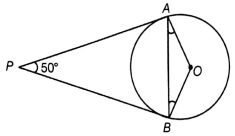
In figure, if PA and PB are tangents to the circle with center O such that ∠APB = 50°, then ∠OAB is equal to
If two tangents inclined at an angle 60° are drawn to a circle of radius 3 cm, then the length of each tangent is
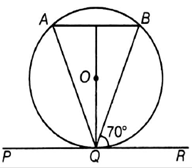
view answer >In figure, if PQR is the tangent to a circle at Q whose center is 0, AB is a chord parallel to PR and ∠BQR = 70°, then ∠AQB is equal to
Exercise 9.2
If a chord AB subtends an angle of 60° at the center of a circle, then angle between the tangents at A and B is also 60°.
view answer >The length of tangent from an external point P on a circle is always greater than the radius of the circle.
view answer >The length of tangent from an external point P on a circle with center 0 is always less than OP.
view answer >The angle between two tangents to a circle may be 0°.
view answer >If angle between two tangents drawn from a point P to a circle of radius a and center O is 90°, then 
If angle between two tangents drawn from a point P to a circle of radius a and center 0 is 60°, then 
The tangent to the circumcircle of an isosceles ΔABC at A, in which AB = AC, is parallel to BC.
view answer >If a number of circles touch a given line segment PQ at a point A, then their centers lie on the perpendicular bisector of PQ.
view answer >If a number of circles pass through the end points P and Q of a line segment PO, then their centers lie on the perpendicular bisector of PQ.
view answer >AB is a diameter of a circle and AC is its chord such that ∠BAC = 30°. If the tangent at C intersect AB extends at D, then BC = BD.
view answer >Exercise 9.3
Out of the two concentric circles, the radius of the outer circle is 5 cm and the chord AC of length 8 cm is a tangent to the inner circle. Find the radius of the inner circle.
view answer >Two tangents PQ and PR are drawn from an external point to a circle with center O. Prove that QORP is a cyclic quadrilateral.
view answer >Prove that the center of a circle touching two intersecting lines lies on the angle bisector of the lines.
view answer >If from an external point B of a circle with center O, two tangents BC and BD are drawn such that ∠DBC = 120°, prove that BC + BD = BO i.e., BO = 2 BC.
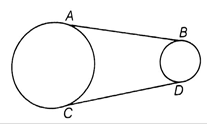
view answer >In figure, AB and CD are common tangents to two circles of unequal radii. Prove that AB = CD
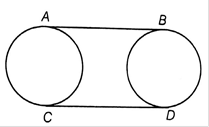
In figure, AB and CD are common tangents to two circles of equal radii. Prove that AB = CD.
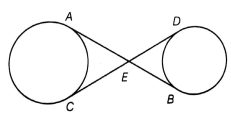
In figure, common tangents AB and CD to two circles intersect at E. Prove that AB = CD.
A chord PQ of a circle is parallel to the tangent drawn at a point R of the circle. Prove that R bisects the arc PRQ.


Prove that the tangents drawn at the ends of a chord of a circle make equal angles with the chord.
view answer >Prove that a diameter AB of a circle bisects all those chords which are parallel to the tangent at the point A.
view answer >Exercise 9.4
If a hexagon ABCDEF circumscribe a circle, prove that
AB + CD + EF = BC + DE + FA
view answer >Let s denotes the semi-perimeter of a ΔABC in which BC = a, CA = b and AB = c. If a circle touches the sides BC, CA, AB at D, E, F, respectively. Prove that BD = s – b.
view answer >From an external point P, two tangents, PA and PB are drawn to a circle with center O. At one point E on the circle tangent is drawn which intersects PA and PB at C and D, respectively. If PA = 10 cm, find the perimeter of the triangle PCD.
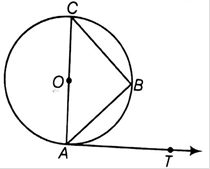
view answer >If AB is a chord of a circle with center O, AOC is a diameter and AT is the tangent at A as shown in figure. Prove that ∠BAT = ∠ACB.
Two circles with centers O and O’ of radii 3 cm and 4 cm, respectively intersect at two points P and Q, such that OP and O’P are tangents to the two circles. Find the length of the common chord PQ.
view answer >In a right angle ΔABC is which ∠B = 90°, a circle is drawn with AB as diameter intersecting the hypotenuse AC at P. Prove that the tangent to the circle at PQ bisects BC.
view answer >In figure, tangents PQ and PR are drawn to a circle such that ∠RPQ = 30°. A chord RS is drawn parallel to the tangent PQ. Find the ∠RQS.
view answer >AB is a diameter and AC is a chord of a circle with center O such that ∠BAC = 30°. The tangent at C intersects extended
AB at a point D. Prove that BC = BD.
view answer >Prove that the tangent drawn at the mid-point of an arc of a circle is parallel to the chord joining the end points of the arc.
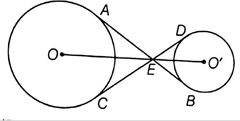
view answer >In a figure the common tangents, AB and CD to two circles with centers O and O’ intersect at E. Prove that the points O, E and O’ are collinear.
In figure, O is the center of a circle of radius 5 cm, T is a point such that OT = 13 and OT intersects the circle at E, if AB is the tangent to the circle at E, find the length of AB.
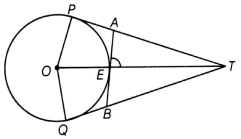
The tangent at a point C of a circle and a diameter AB when extended intersect at P. If ∠PCA = 110°, find ∠CBA.
view answer >If an isosceles ΔABC in which AB = AC = 6cm, is inscribed in a circle of radius 9 cm, find the area of the triangle.
view answer >A is a point at a distance 13 cm from the center O of a circle of radius 5 cm. AP and AQ are the tangents to the circle at P and Q. If a tangent BC is drawn at a point R lying on the minor arc PQ to intersect AP at B and AQ at C, find the perimeter of the ΔABC.
view answer >