
Using the principle of mathematical induction, prove each of the following for all n ϵ N:

To Prove:

Let us prove this question by principle of mathematical induction (PMI)
Let P(n): 
For n = 1
LHS = 
RHS =  1
1
Hence, LHS = RHS
P(n) is true for n = 1
Assume P(k) is true
 ……(1)
……(1)
We will prove that P(k + 1) is true
RHS = 
LHS = 
 [ Writing the last
Second term ]
=  [From 1]
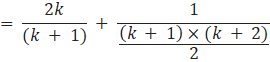
{ 1 + 2 + 3 + 4 + … + n = [n(n + 1)]/2 put n = k + 1 }


= 
[ Taking LCM and simplifying ]
= 
= RHS
Therefore , 
LHS = RHS
Therefore, P (k + 1) is true whenever P(k) is true.
By the principle of mathematical induction, P(n) is true for×
where n is a natural number
Put k = n - 1

Hence proved
Couldn't generate an explanation.
Generated by AI. May contain inaccuracies — always verify with your textbook.


