Skip to content
Philoid
Browse Saved
Back to chapter
Maths
15. Mean Value Theorems
Home · Class 12 · Maths · Ref. Book · 15. Mean Value Theorems
Prev
Next
Q3 of 96 Page 15

Mark the correct alternative in the following:

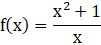
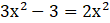
For the function the value of c for the Lagrange’s mean value theorem is


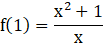
It shows that f(x) is continuous on 1, 3 and derivable on 1, 3.


So, both the conditions of Lagrange’s Theorem are satisfied.


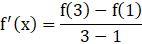
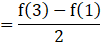
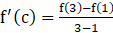
Consequently, there exists c Є 1, 3 such that
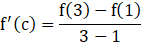


Hence, Є (1, 3) such that .


Hence, Option (B) is the answer.

More from this chapter

All 96 →
1

Mark the correct alternative in the following:

If the polynomial equation a0xn + an–1xn–1 + an–2xn–2 + …. a2x2 + a1x + a0 = 0


n being a positive integer, has two different real roots α and β, then between α and β, the equation n anxn–1 + (n–1) an–1xn–2 + … + a1 = 0 has


2

Mark the correct alternative in the following:

If 4a + 2b + c = 0, then the equation 3ax2 + 2bx + c = 0 has at least one real root lying in the interval.


4

Mark the correct alternative in the following:

If from Lagrange’s mean value theorem, we have then


5

Mark the correct alternative in the following:

Rolle’s theorem is applicable in case of ϕ (x) = asinx, a > 0 in


Questions · 96
15. Mean Value Theorems
1 1 1 1 1 1 2 2 2 2 2 2 2 2 3 3 3 3 3 3 3 3 3 3 3 3 3 3 3 3 3 3 4 5 5 5 6 7 7 8 1 1 1 1 1 1 1 1 1 1 1 1 1 1 1 1 2 3 4 5 6 7 8 9 10 11 1 2 3 4 5 6 7 8 9 10 11 1 2 3 4 5 1 2 3 4 5 6 7 8 9 10 11 12 13 14
Back to chapter
ADVERTISEMENT
About Contact Privacy Terms
Philoid · 2026
  • Home
  • Search
  • Browse
  • Quiz
  • Saved