
Verify Rolle’s theorem for each of the following functions on the indicated intervals :

First, let us write the conditions for the applicability of Rolle’s theorem:
For a Real valued function ‘f’:
a) The function ‘f’ needs to be continuous in the closed interval [a,b].
b) The function ‘f’ needs differentiable on the open interval (a,b).
c) f(a) = f(b)
Then there exists at least one c in the open interval (a,b) such that f’(c) = 0.
Given function is:
⇒ 
We know that sine function is continuous and differentiable over R.
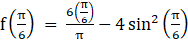
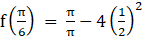
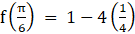
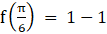
Let’s check the values of function ‘f’ at the extremums,
⇒ 
⇒ f(0) = 0 – 4(0)
⇒ f(0) = 0
⇒ 
⇒ 
⇒ 
⇒ 
⇒  .
.
We got  . So, there exists a cϵ
 such that f’(c) = 0.
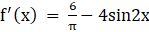
Let’s find the derivative of function ‘f.’
⇒ 
⇒ 
⇒ 
⇒ 
⇒ 
We have f’(c) = 0
⇒ 
⇒ 
⇒ 
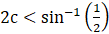
We know 
⇒ 
⇒ 
⇒ 
⇒ 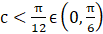
∴ Rolle’s theorem is verified.
Couldn't generate an explanation.
Generated by AI. May contain inaccuracies — always verify with your textbook.
