
Mark the correct alternative in the following :
If in the expansion of (1 + y)n, the coefficients of 5th, 6th and 7th terms are in A.P., then n is equal to
Given:
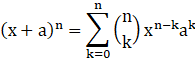
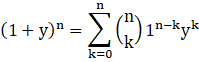
T5 ; T6
; T6 & T7
& T7
Since T5 , T6 & T7 are in AP
Then; 2(T6) = T5 + T7
i.e. 




⇒ 30+(n-4) (n-5)-12(n-4)=0
⇒30+n2-9n+20-12n+48=0
⇒n2-21n+98=0
⇒ (n-7) (n-14)=0
⇒n=7,14
AI is thinking…
Couldn't generate an explanation.
Generated by AI. May contain inaccuracies — always verify with your textbook.


