
A point charge is moving along a straight line with a constant
velocity v. Consider a small area A perpendicular to the direction of motion of the charge figure. Calculate the displacement current through the area when its distance from the charge is x. The value of x is not large so that the electric field at any instant is essentially given by Coulomb’s law.

Given: Velocity of charge = v
Area of patch = A
Distance of charge from the patch=x
We have to find the displacement current through the area when it is at a distance x from the charge.
The displacement current arises due to changing electric field which in turn produces a varying electric flux through an area. The displacement current depends on the electric flux as
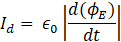
where Id is the displacement current,ϕE is the varying electric flux
through the area and ϵ0 is the electric permittivity of free
space(vacuum) and is equal to 8.85 × 10⁻¹² C2 N-1 m-2.
The electric field produced by the charge when it is at a distance x
from the surface is given by Coulumb’s law and is equal to

This electric field produces an electric flux through the area whose
magnitude is given by Gauss’s law

 . This is because the electric field lines are directed along the normal to the area vector of the surface.
The angle θ between them is 0° so cos 0° =1.

The displacement current will be

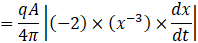
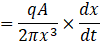
As x is the distance of the charge from the area at different intervals of time so the rate at which the particle is changing its position is its velocity v

Thus the displacement current through the area is 
Couldn't generate an explanation.
Generated by AI. May contain inaccuracies — always verify with your textbook.
