
A parallel-plate capacitor having plate-area A and plate separation
d is joined to a battery of emf ϵ and internal resistance R at t = 0.
Consider a plane surface of area A/2, parallel to the plates and
situated symmetrically between them. Find the displacement current
through this surface as a function of time.
Given: Area of capacitor plates=A
Separation between the plates=d
Emf of the battery = ϵ
Internal resistance of the battery = R
Area of plane surface= A/2
Displacement current is the current which is generated by a time
varying electric field, not by the flow of charge carriers.
This current is also responsible for the generation of a time varying
magnetic field. The displacement current Id is generated due to the
fact that the charge on capacitor plates is changing with time.
The displacement current is given by

where ϕE is the time varying electric flux through the plane surface
and ϵ0 is the electric permittivity of free space(vacuum) and is equal
to 8.85 × 10⁻¹² C2 N-1 m-2.
The electric field in the space between the plates can be given by
Guass’s Law. If the charge on the capacitor plate is Q and the area
of the plate is A(given), then by Guass’s law,

where E is the electric field and ϵ0 is the electric permittivity of free
space and dS is a small area element on the plate.
Further  (because the area vector
and electric field lines are both normal to the surface and in
same direction i.e. θ=0° so cos θ=1)
So  →
→  , the electric field between the plates is
  .
.
This electric field produces and electric flux through the plane
surface given by

(because the area vector and electric field lines are both normal to
the surface and in same direction i.e. θ=0° so cos θ=1)

Now the charge on the capacitor is changing with time as it is
charging. If the capacitance of the capacitor is C, then the charge Q
at time t will be
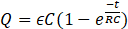 where ϵ is the potential between plates which is equal to the emf of battery and R is the resistance attached in series.
The displacement current Id is given as
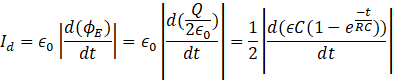
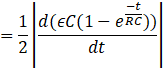


Thus the displacement current as a function of time is  .
.
Couldn't generate an explanation.
Generated by AI. May contain inaccuracies — always verify with your textbook.

